
What happened
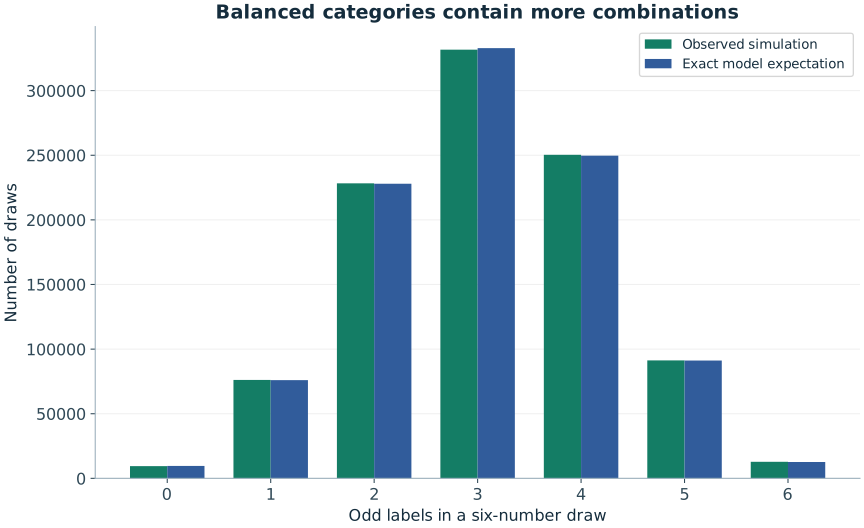
Exactly three odd labels appeared in 33.1666% of draws; six odd labels appeared in 1.2827%. Every valid individual set was generated by the same uniform procedure.
The broad categories contain different numbers of sets. The 3-odd category contains C(25,3)C(24,3) sets, while the all-odd category contains C(25,6). The relative sizes explain their different frequencies without assigning different probabilities to individual sets.
Method and benchmark
Group one million uniform 6/49 draws by odd count. Compare each category with C(25,r)C(24,6−r)/C(49,6).
The pool has 25 odd and 24 even labels. All seven possible odd counts are measured, and their observed counts sum to one million. Their exact model probabilities also sum to one, providing both an empirical and an algebraic partition check.
Python 3.12.14 · NumPy 2.3.5 · NumPy PCG64 · seed 20260929. Each experiment starts a separate stream. Code and all datasets are linked below.
What this does not establish
A category contains many combinations. Comparing categories does not compare the probabilities of two specified tickets.
This experiment does not rank number-selection strategies. Selecting one balanced set does not purchase every set in the balanced category. The accompanying category sketch uses coin strings to make that same distinction in a smaller, fully visible outcome space.
These are original educational simulations prepared for RoomForChance. They are not historical lottery records, a physical-machine audit, an external peer review or evidence of a prediction advantage.
Inspect the data
Download parity-categories.csv · All results and metadata (JSON) · Download the complete Python program · Download figure-generation code
| odd count | observed | expected |
|---|---|---|
| 0 | 9,470 | 9,625.12665 |
| 1 | 76,136 | 75,987.8419 |
| 2 | 228,280 | 227,963.526 |
| 3 | 331,666 | 332,899.117 |
| 4 | 250,352 | 249,674.338 |
| 5 | 91,269 | 91,185.4103 |
| 6 | 12,827 | 12,664.6403 |
Reproduce the experiment
Download the Python program to an empty working folder. Use the recorded environment for an exact replay. The program runs all eleven studies and creates a lab-data folder containing the result files. The largest study performs ten million draws; allow time for it to finish.
python -m pip install numpy==2.3.5
python run_experiments.py
Expected CSV SHA-256: e0074e22281ff10f88895b6a2c388a357868fe1d65c6ff1e8eb4714c05a61f50. A matching seed alone is insufficient if you change the implementation or call sequence. The CSV files use CC BY 4.0; the original code uses the MIT license included with the downloads.
Read the reasoning
Are Birthday Numbers a Bad Idea? Winning and Sharing Are Different
Why birthday selections have equal draw odds but may concentrate player choices, and why that does not establish a guaranteed financial advantage.
Are Balanced Lottery Numbers Better? Odd and Even Categories Explained
Compute odd/even category probabilities while showing why a three-odd three-even line has no individual advantage over an all-odd line.
UK Lotto Mathematics: Why a Single 6/59 Round Has 45,057,474 Outcomes
Understand the UK Lotto 6/59 main-number calculation, the Bonus Ball distinction and why a per-round probability is not a whole-event probability.
Technical references
NumPy PCG64 documentation describes the generator family. Harvard Stat 110 provides university-level probability background. The model-specific derivation is linked above.