
A uniform round selecting six distinct main labels from 1–59 has C(59,6) = 45,057,474 possible main sets. A specified six-label line therefore matches all six in that round with probability 1/45,057,474. This guide states the unit explicitly: one main-number round.
Do not automatically treat a per-round denominator as the probability across an entire product or event containing additional opportunities. The operator's current rules determine what an official entry includes.
Why the familiar 6/49 figure is different C(49,6) = 13,983,816 describes a 49-label pool. Increasing the pool to 59 while keeping six selections produces many more sets. The formula has not changed; the input has.
This is a common source of stale lottery explanations. A widely remembered denominator can be correct for one model and incorrect for a current named game. The calculator's UK Lotto preset uses n = 59 and k = 6 and labels its result per round.
The Bonus Ball is not a seventh selected main label For a model where a bonus is drawn from the remaining 53 labels after six main balls, it is part of the operator's extraction, not an extra number the player adds to the six-label line. A full six-main match already fixes the main set, so its denominator is C(59,6).
Multiplying the main-match denominator by 53 would answer a different event involving a specified bonus. It would not describe the ordinary six-main match.
Five main matches plus the bonus For a fixed six-label line, choose which five of its labels appear among the main balls in six ways. The remaining main label can be any of the 53 outside the line. The bonus must then be the one omitted ticket label, with probability 1/53.
The factors of 53 cancel, leaving probability 6/C(59,6), or one in 7,509,579, for that specific one-round match pattern. The derivation is more informative than treating the bonus as an independent separate pool.
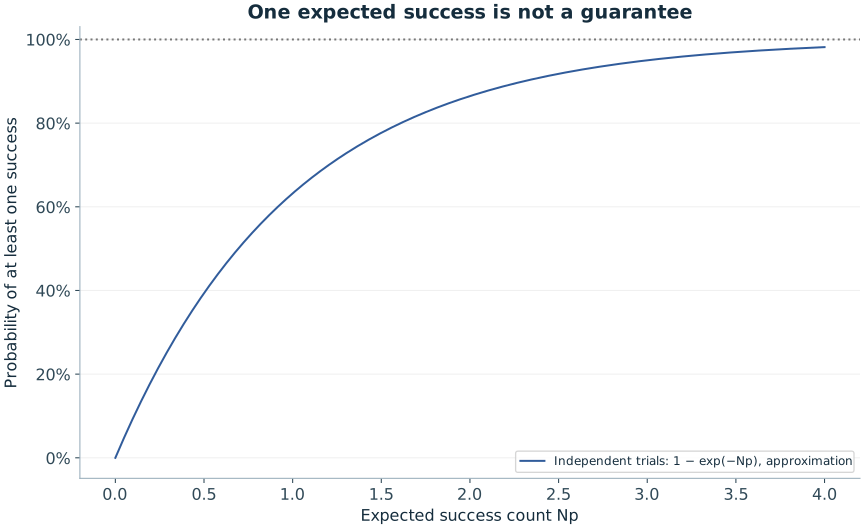
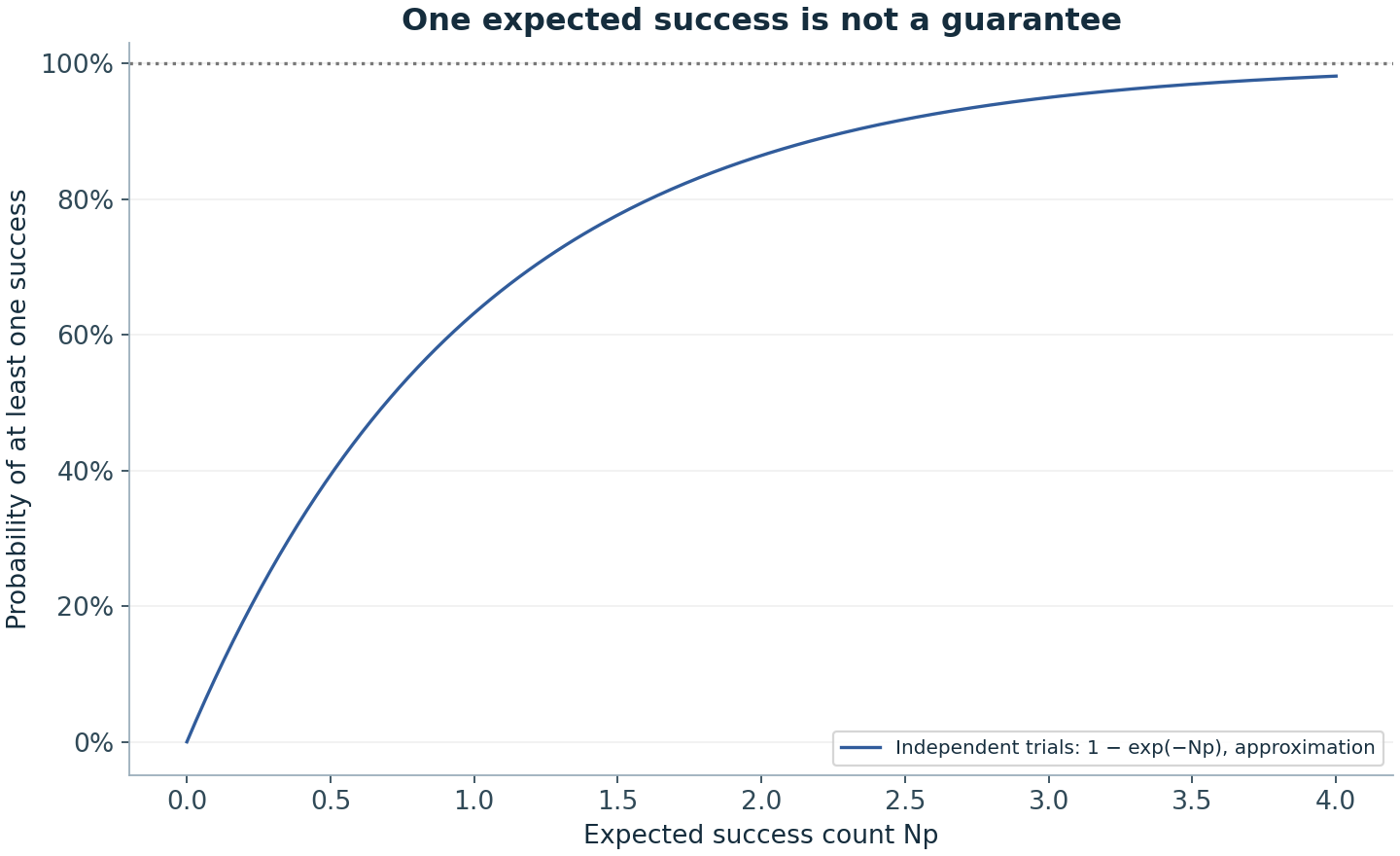
Combining independent rounds requires another step If the same eligible line participates in d independent rounds with the same uniform matrix, the probability of at least one six-main match is 1−(1−1/C(59,6))^d. This is a model formula, not a substitute for checking which rounds and prize conditions the official product actually includes.
Additional codes, promotions or tier rules should be analysed separately rather than folded into the main denominator without explanation.
Lucky Dip and personal selection Under the uniform model, a valid line selected personally and one supplied at random have the same six-main match probability per round. Recent winners, consecutive labels and odd/even balance do not change that.
The linked Lotto generator supplies six distinct labels and explains its scope. Use it for selection, and use the official operator for entry conditions and current prize rules. Keeping the model and the product separate prevents a correct combinatorial calculation from becoming an overstated claim about an entire purchase.
Leave the selection to chance
If you want a valid random game line, open the relevant generator. A generated line is not an official entry or a prediction, and it does not improve the probability of a specified valid combination.
Sources and further reading
The worked examples and derivations are RoomForChance explanations. Operator sources establish game parameters; research sources support the specific points identified above. University links are references, not endorsements.
- The National Lottery · Player informationOfficial source describing Lotto, EuroMillions, Set For Life and Thunderball selection pools, checked 22 September 2026.
- The National Lottery · Current Lotto conditionsConsult the operator for whole-event entry conditions. Our calculation is explicitly for one 6/59 main round.
- Joe Blitzstein and Jessica Hwang · Harvard Stat 110 / Introduction to ProbabilityUniversity-level further reading on counting, conditioning and probability models.
Continue the argument
How Many Lottery Combinations Are There? The C(n,k) Formula
Derive the lottery combination formula, work through C(49,6), and learn when separate pools or ordered digits require a different count.
How Bonus Balls and Separate Number Pools Change Lottery Odds
Separate special-ball pools and bonus balls drawn from the main pool need different formulas. Learn the distinction with worked examples.
Do More Lottery Tickets Increase Your Odds? The Exact Mathematics
Compare distinct lines in one draw, duplicate lines and repeated independent draws without confusing relative improvement with a likely win.