
For a lottery selecting k distinct main numbers from n labels, with order irrelevant, the number of possible main combinations is C(n,k) = n!/[k!(n−k)!]. Read this as “n choose k”. It counts sets, not the order in which the balls leave a machine.
This formula is short because it compresses two operations: count ordered selections, then remove repeated counting of the same set.
Derive it from a small example Choose two labels from {1,2,3,4}. There are four choices first and three second, giving 12 ordered outcomes. But 1 then 2 and 2 then 1 describe the same set. Every set has two orders, so divide 12 by 2 to obtain six combinations.
For k labels, every set has k! orders. The ordered count n(n−1)…(n−k+1), divided by k!, gives C(n,k). The factorial notation is simply a compact way to write this product.
Work through 6/49 C(49,6) = (49 × 48 × 47 × 46 × 45 × 44)/(6 × 5 × 4 × 3 × 2 × 1) = 13,983,816. A specified six-number set has probability one divided by that count under a uniform draw.
This is a generic 6/49 model. It should not be labelled as current UK Lotto, whose main pool is 59. C(59,6) = 45,057,474. A familiar historic number can become a factual error when it is attached to the wrong current game.
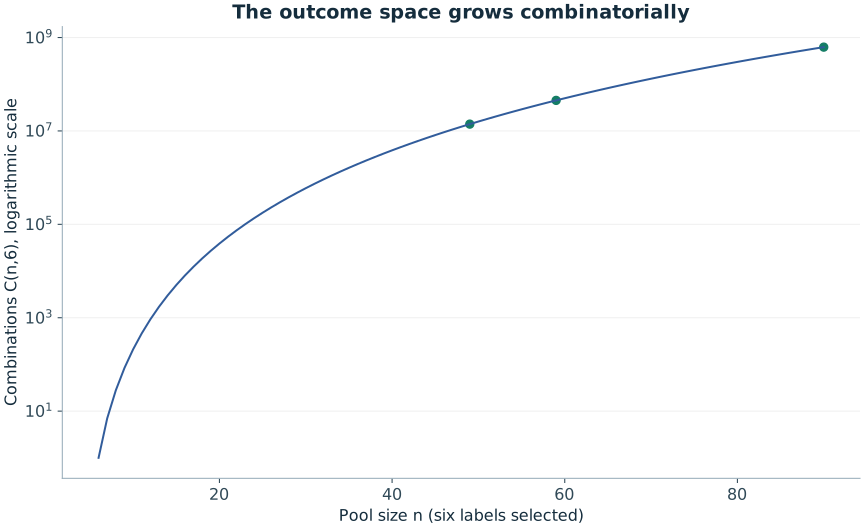
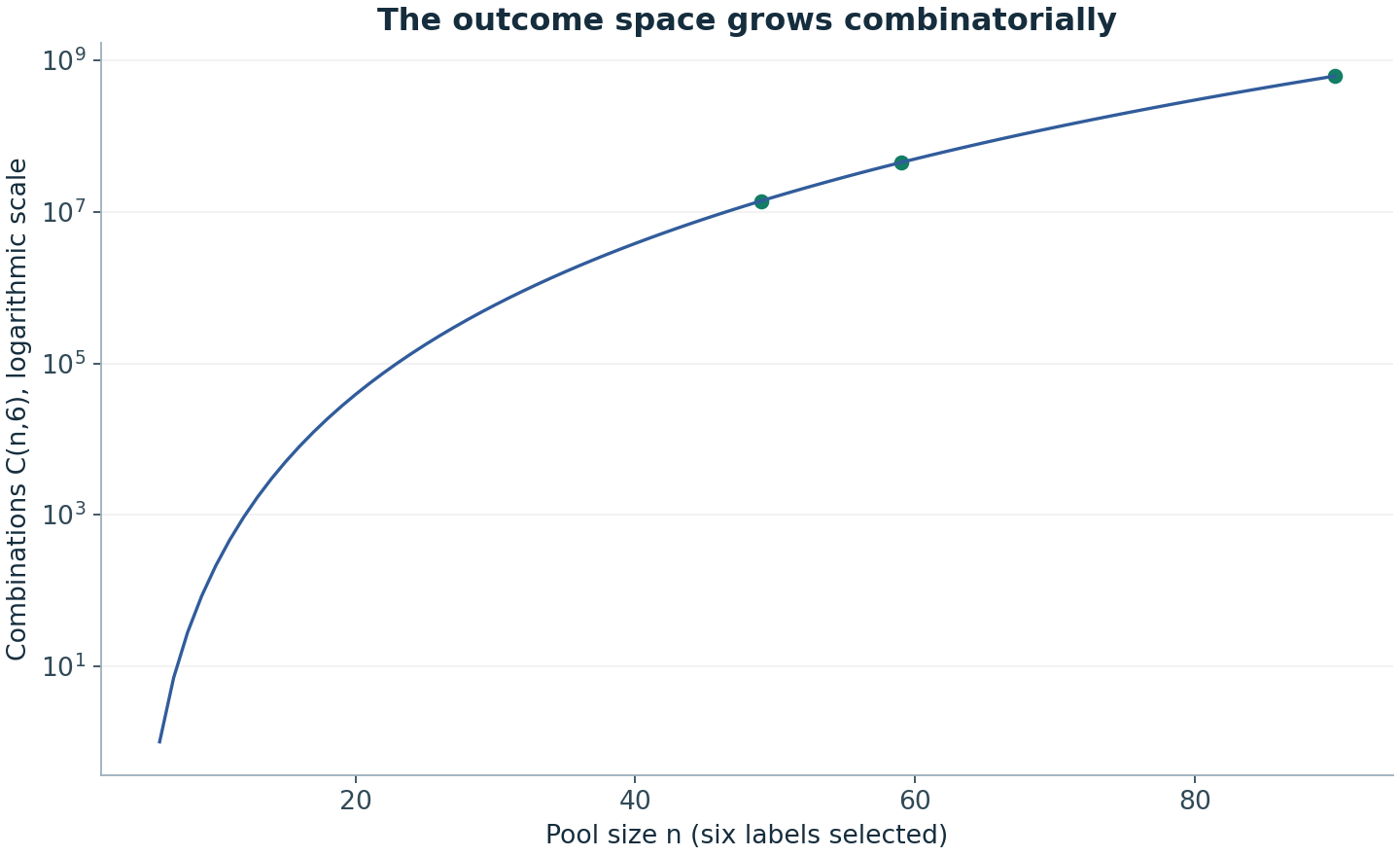
Why adding a number can change the odds dramatically Compare C(n+1,k) with C(n,k). Their ratio is (n+1)/(n+1−k). The increase depends on both the pool size and the number selected. Adding another selected ball can have an even larger effect because the number of possible sets changes combinatorially, not linearly.
For fixed n, C(n,k) = C(n,n−k). Choosing the included labels determines the excluded labels. This symmetry is also useful when calculating large combinations efficiently.
Do not multiply by the wrong bonus factor A separate pool of b labels from which one special ball is selected contributes a factor b. A separate s-of-b pool contributes C(b,s). A bonus drawn from the leftover main balls is not a separate independent pool and may not affect the top-prize match at all. Read the prize definition before changing the formula.
An ordered digit game with replacement is different again. Three positions, each allowing 0–9, have 10^3 = 1,000 ordered outcomes. Repeated digits are allowed and 123 differs from 321. C(10,3) would answer the wrong question.
Use the calculator as a model check Enter the pool and selection sizes, then inspect the displayed formula. The optional second pool means a separately selected set, not every possible kind of bonus. Exact integer counts are displayed separately from rounded probability percentages.
A combination count tells you how many valid outcomes exist. It does not say which outcome will occur, and it does not make a smaller-looking or more evenly distributed line more likely.
Leave the selection to chance
If you want a valid random game line, open the relevant generator. A generated line is not an official entry or a prediction, and it does not improve the probability of a specified valid combination.
Sources and further reading
The worked examples and derivations are RoomForChance explanations. Operator sources establish game parameters; research sources support the specific points identified above. University links are references, not endorsements.
- The National Lottery · Player informationOfficial source describing Lotto, EuroMillions, Set For Life and Thunderball selection pools, checked 22 September 2026.
- Joe Blitzstein and Jessica Hwang · Harvard Stat 110 / Introduction to ProbabilityUniversity-level further reading on counting, conditioning and probability models.
Continue the argument
Combinations vs Permutations: Does Order Matter?
Distinguish unordered lottery sets from ordered digit games, with replacement rules and examples that prevent common counting errors.
How Bonus Balls and Separate Number Pools Change Lottery Odds
Separate special-ball pools and bonus balls drawn from the main pool need different formulas. Learn the distinction with worked examples.
UK Lotto Mathematics: Why a Single 6/59 Round Has 45,057,474 Outcomes
Understand the UK Lotto 6/59 main-number calculation, the Bonus Ball distinction and why a per-round probability is not a whole-event probability.