
A bonus ball is not one universal mathematical object. Some games use an independently selected special ball from a separate pool. Others draw an additional ball from the remaining main pool. Some require the special ball for the top prize; others use a bonus only to distinguish a lower tier. The formula must follow the rule, not the word “bonus”.
A separate one-ball pool Suppose a game selects five main labels from 1–69 and one special label from 1–26. There are C(69,5) possible main sets and 26 possible special outcomes. The full-match count is their product: 292,201,338.
A main label and a special label can have the same numeral because they belong to different pools. Excluding matching numerals would remove valid outcomes. The multiplication also assumes the pool selections follow the stated independent uniform model.
A separate multi-ball pool For five main labels from 50 and two distinct stars from 12, the full outcome count is C(50,5)C(12,2) = 139,838,160. The star count is 66, not 12 × 12: repetition is not allowed, and star order does not matter.
Partial matching across pools combines their separate probabilities. Exactly r main matches and s star matches has probability [C(5,r)C(45,5−r)/C(50,5)] × [C(2,s)C(10,2−s)/C(12,2)]. The word “exactly” matters here: zero star matches is not the same as ignoring the stars.
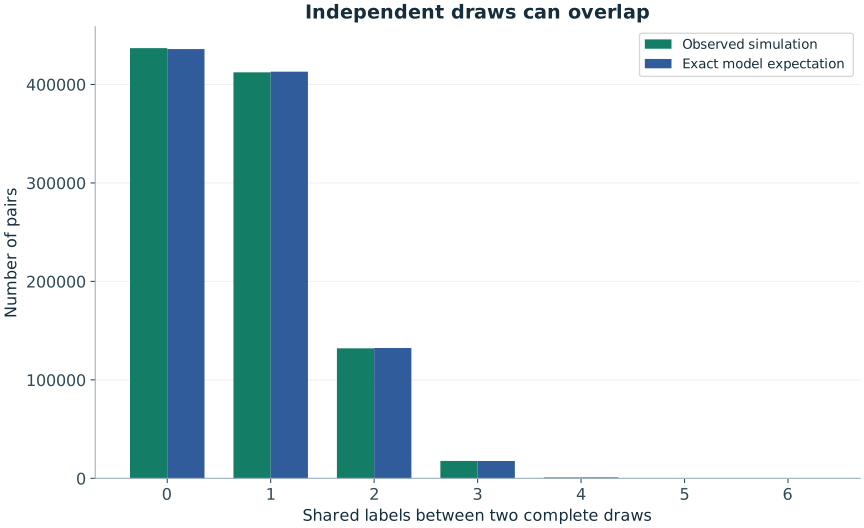
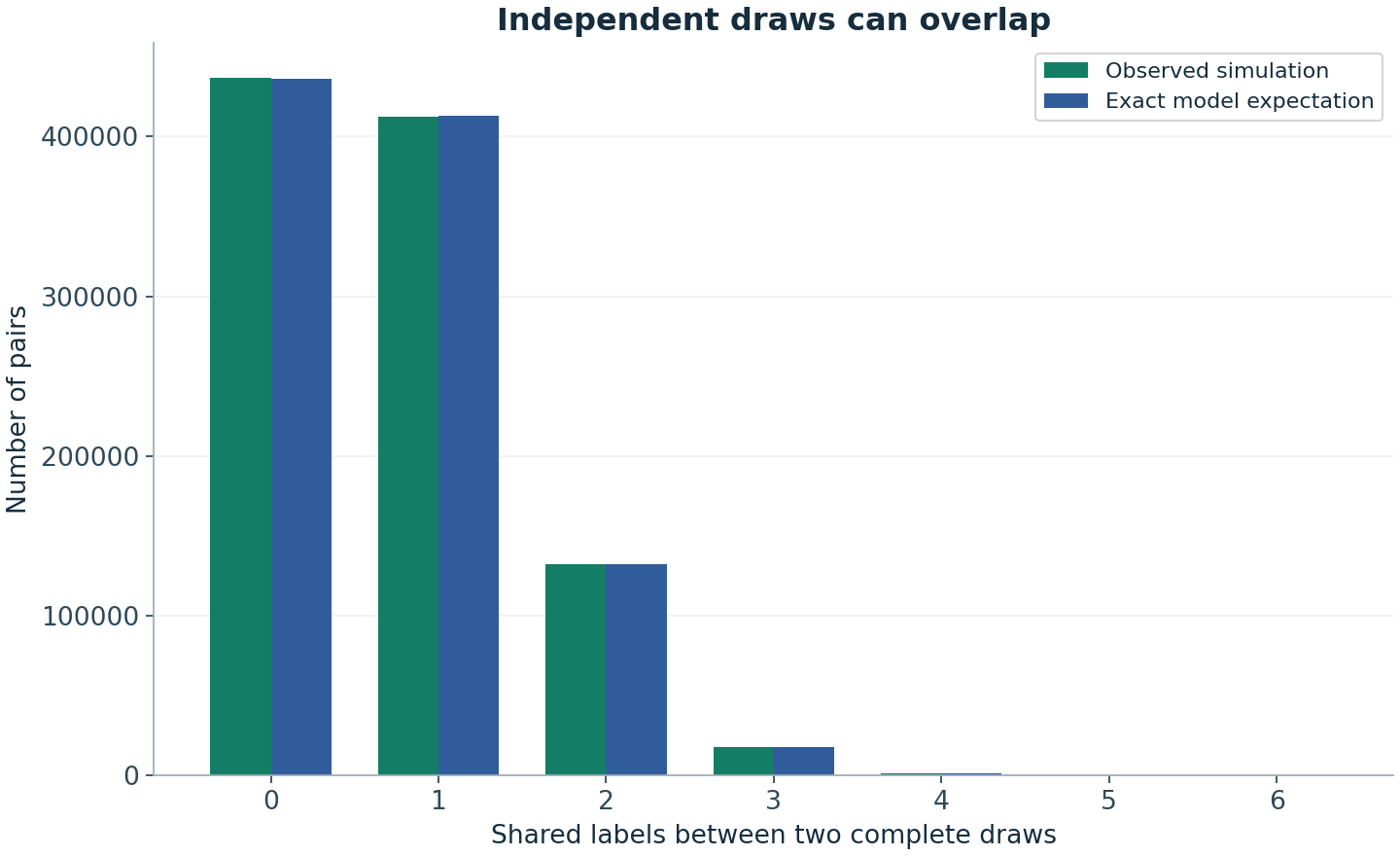
A bonus from the remaining main pool Now consider six main labels drawn from n and a bonus drawn from the n−6 remaining labels. For a fixed six-number ticket to match five main numbers plus the bonus, the main draw must contain five ticket labels and one non-ticket label, and the bonus must be the one missing ticket label.
There are C(6,5)C(n−6,1) favourable main sets. For each, the required bonus has probability 1/(n−6). Multiply and divide by C(n,6): the probability simplifies to 6/C(n,6). This is not obtained by treating the bonus as an independent pool of n labels.
The top prize may ignore the bonus If matching all six main labels already wins the top prize, the bonus does not multiply its denominator. It distinguishes other tiers. Appending an extra bonus factor to the jackpot count would incorrectly make the jackpot look harder.
Why calculators need a scope statement Our combinations calculator's optional second pool means a genuinely separate pool with distinct unordered selections. It is not a switch for every rule involving a bonus ball. For a remaining-main-pool bonus, use a dedicated derivation matching the prize condition.
Check the current official game rules before entering parameters. Mathematical formulas can remain correct while a game's pools change. In the game-specific guides, the cited operator pages establish the pool definitions and the article shows the arithmetic independently. That makes the calculation inspectable instead of asking the reader to trust a copied headline denominator.
Leave the selection to chance
If you want a valid random game line, open the relevant generator. A generated line is not an official entry or a prediction, and it does not improve the probability of a specified valid combination.
Sources and further reading
The worked examples and derivations are RoomForChance explanations. Operator sources establish game parameters; research sources support the specific points identified above. University links are references, not endorsements.
- Powerball · Official game informationPool definitions checked 22 September 2026; the displayed jackpot and other live information can change.
- The National Lottery · Player informationOfficial source describing Lotto, EuroMillions, Set For Life and Thunderball selection pools, checked 22 September 2026.
- Joe Blitzstein and Jessica Hwang · Harvard Stat 110 / Introduction to ProbabilityUniversity-level further reading on counting, conditioning and probability models.
Continue the argument
EuroMillions Odds: Five Numbers, Two Lucky Stars and 139,838,160 Outcomes
Derive EuroMillions match probabilities, including five main numbers with no Lucky Stars, and keep raffle codes separate from the number matrix.
Powerball Odds Explained: Why the Jackpot Is 1 in 292,201,338
Derive US Powerball’s full-match probability from five white balls and a separate red ball, and distinguish jackpot odds from partial matches.
How to Calculate the Probability of Matching Lottery Numbers
Derive the hypergeometric formula for exactly r matches and distinguish exact, at-least and separate-pool matching events.