
Use combinations when choosing a set and permutations when arranging distinct items in order. But “Does order matter?” is only the first question. You must also ask whether values may repeat. Together, these two choices determine which counting model fits the game.
Four models that look deceptively similar Choose three distinct labels from ten and ignore order: there are C(10,3) = 120 outcomes. Choose three distinct labels and preserve order: there are 10 × 9 × 8 = 720. Choose three ordered digits with repetition allowed: there are 10^3 = 1,000. Choose a three-item multiset with repetition allowed but no order: there are C(12,3) = 220.
These numbers answer four different questions. None is a more sophisticated version of another; each describes a different sample space. In particular, equally likely ordered sequences do not automatically make all unordered multisets equally likely when repetitions are allowed.
Why standard main-number lotteries divide by k! If six distinct numbers can leave a machine in any order, one fixed set has 6! ordered arrangements. Every set has the same number of arrangements. Dividing the ordered outcome count by 6! therefore treats all sets consistently.
That reasoning fails if repetitions are allowed and you simply assume every multiset has the same number of orders. The digits 1,1,1 have one distinct arrangement, while 1,2,3 have six. Forgetting order in a uniform digit sequence produces unequal probabilities across multiset categories.
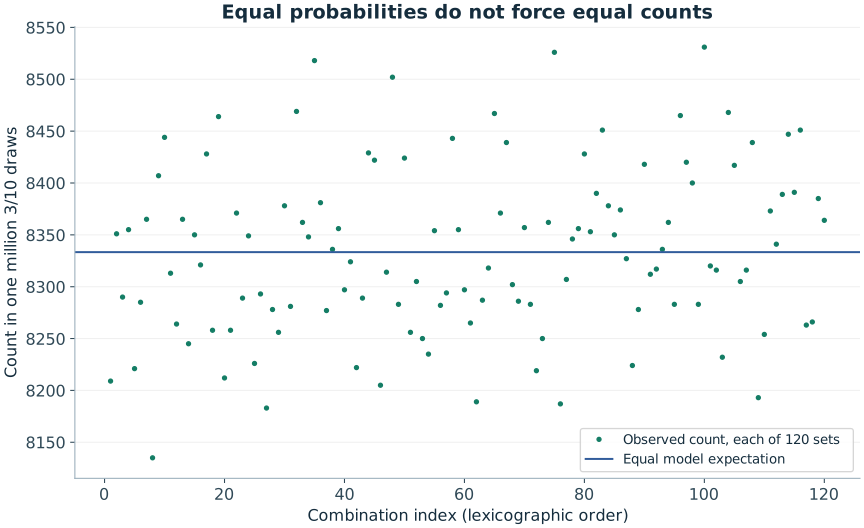
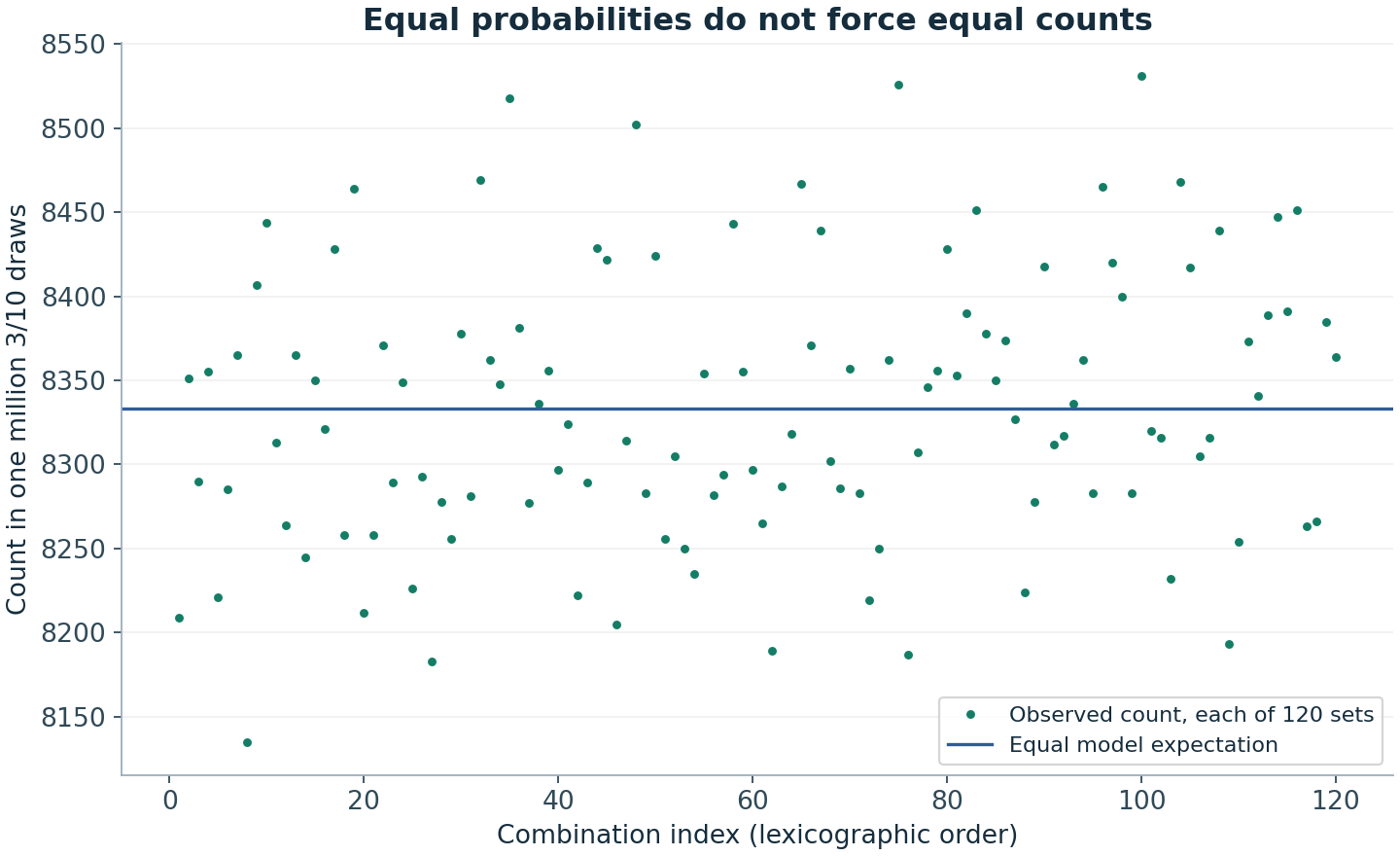
A box-style example In a three-digit game with 1,000 equally likely ordered results, an exact selection 123 has probability 1/1,000. The event “any ordering of 1,2,3” contains six outcomes and has probability 6/1,000. Any ordering of 1,1,2 contains only three outcomes, while 1,1,1 contains one.
This does not establish a better-value purchase. Actual game products can charge differently or pay different amounts for those categories. Probability and payout must be considered separately, and the official rules determine what a ticket actually covers.
Display order is not necessarily winning order A website may show main lottery numbers in ascending order for readability. That does not mean the machine draws them in ascending order, and it does not make their positions independent. Conversely, a digit game may display positions because the positions are part of the winning condition.
Before calculating, write one sentence: “Two results count as the same outcome if…” If changing the order leaves the winning condition unchanged, you probably need a set-based model. If it changes the condition, preserve the order.
A reliable calculation sequence Identify the available labels, the number of selections, whether replacement occurs, and the winning condition. Count the outcomes using those rules. Only then convert the count into a probability under a stated distribution.
The combinations tool deliberately describes its scope as distinct, unordered selections with an optional separate pool. It should not be used for every digit game merely because the game involves numbers. A mathematically correct calculation becomes misleading when applied to the wrong model.
Leave the selection to chance
If you want a valid random game line, open the relevant generator. A generated line is not an official entry or a prediction, and it does not improve the probability of a specified valid combination.
Sources and further reading
The worked examples and derivations are RoomForChance explanations. Operator sources establish game parameters; research sources support the specific points identified above. University links are references, not endorsements.
- Joe Blitzstein and Jessica Hwang · Harvard Stat 110 / Introduction to ProbabilityUniversity-level further reading on counting, conditioning and probability models.
Continue the argument
With vs Without Replacement: The Probability Difference
Understand how replacing a drawn item changes independence, duplicate possibilities and the formulas used for lottery and digit games.
How Many Lottery Combinations Are There? The C(n,k) Formula
Derive the lottery combination formula, work through C(49,6), and learn when separate pools or ordered digits require a different count.
How to Calculate the Probability of Matching Lottery Numbers
Derive the hypergeometric formula for exactly r matches and distinguish exact, at-least and separate-pool matching events.