
Sampling with replacement returns each selected item to the pool before the next selection. Sampling without replacement leaves it out. That small procedural difference changes which outcomes are possible and whether later selections depend on earlier ones.
Consider a bag with five numbered balls. With replacement, drawing ball 2 first leaves five possibilities for the next draw. Without replacement, only four remain, and ball 2 cannot appear again during that sample.
Independence inside a sample Under uniform sampling with replacement, two specified ordered labels each have probability 1/5, so their joint probability is 1/25. Repeated outcomes such as 2 then 2 are allowed.
Without replacement, two different specified labels have joint probability (1/5)(1/4) = 1/20. The event 2 then 2 has probability zero. The second label's distribution conditional on the first has changed, so the selections are dependent.
However, before observing the first ball, each label still has probability 1/5 of occupying the second position. Uniform marginal distributions do not imply independence. This distinction is a useful antidote to many overly simple explanations of lottery draws.
Matching numbers uses the remaining pool For a fixed six-number ticket in a 6/49 lottery, exactly r matches occur when the draw includes r of your six labels and 6−r of the other 43. The probability is C(6,r)C(43,6−r)/C(49,6).
A binomial calculation with six independent success opportunities would not preserve the without-replacement structure. Once a matching label is selected, both the remaining pool and the remaining matching labels change. The hypergeometric count handles those changes together.
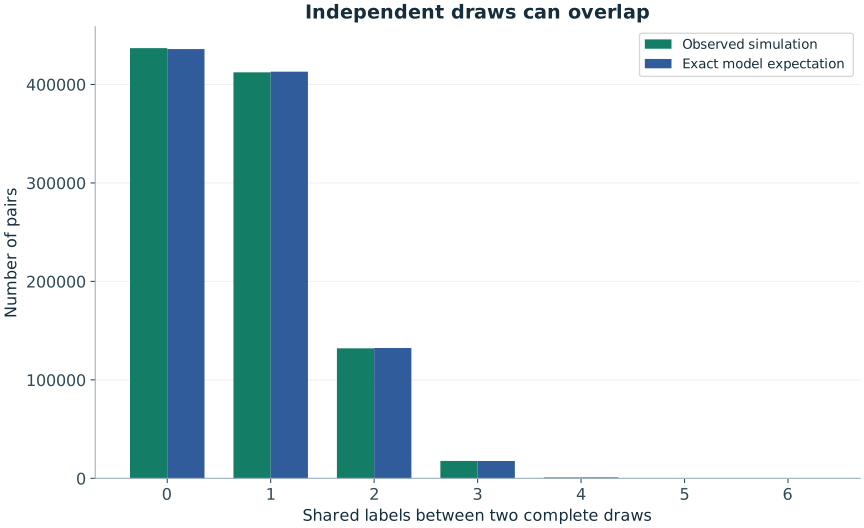
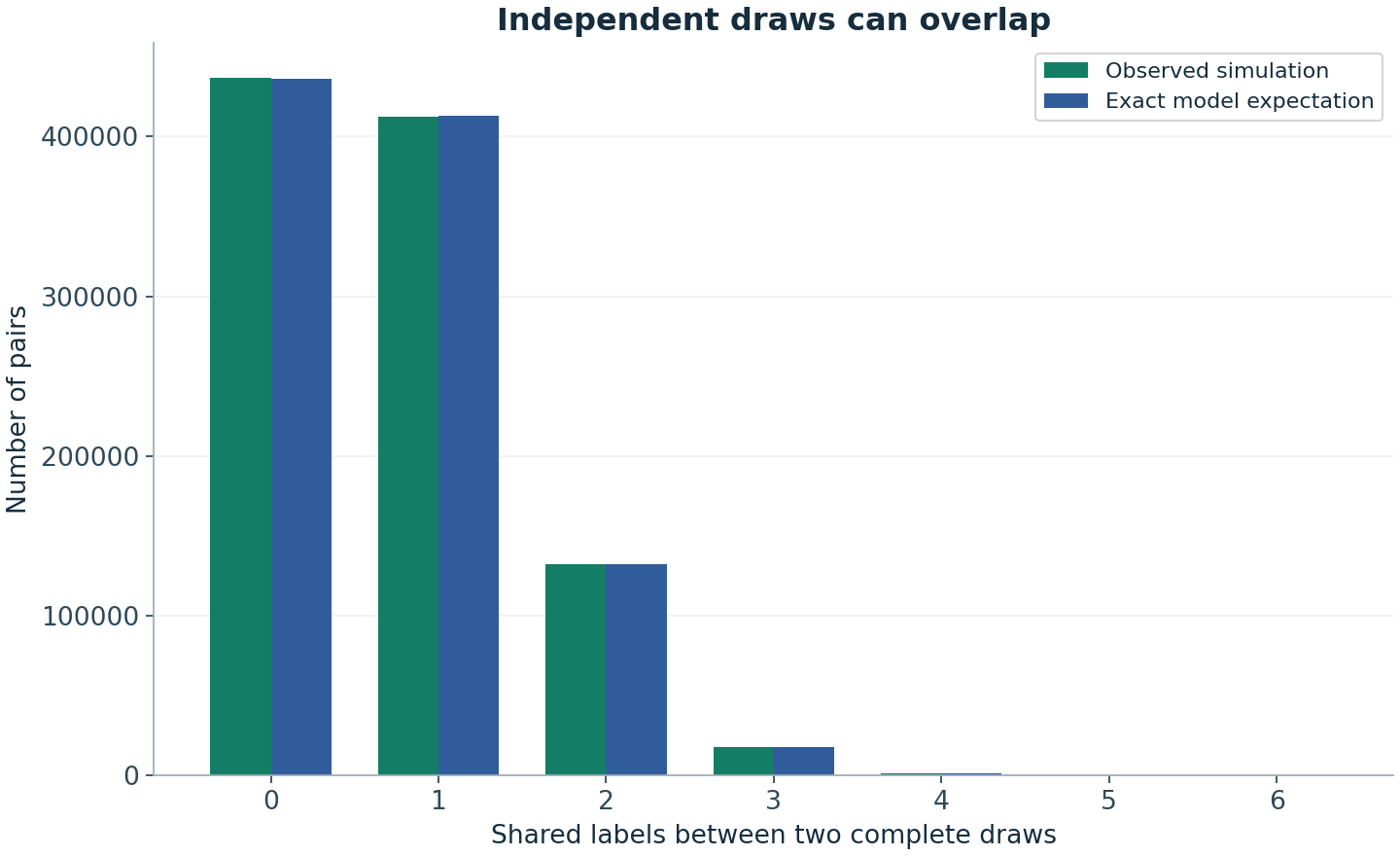
Replacement between complete draws A lottery can sample without replacement within each draw and restore the full pool between draws. This is the usual conceptual distinction behind the statement that separate draws have no memory. Last week's selected labels are eligible again this week.
Excluding recent winners from your own line is therefore not a consequence of the game's without-replacement rule. It adds a personal restriction that the next draw does not share.
Separate pools are separate samples A main-number pool and a special-ball pool can contain the same numerical labels. The numeral 7 in one pool is not the physical or logical item 7 in the other. A repeated numeral across pools can be valid even when neither pool permits duplicates internally.
This matters in both generators and calculators. If software treats the two pools as one shared set, it produces the wrong outcome space and the wrong odds.
A practical modelling habit Describe the replacement rule at every level: within a main pool, within a special pool, and between complete trials. Avoid using one blanket phrase for all three. Then check that the experiment or calculator follows exactly that description.
Our overlap experiment restores the pool for each fresh draw. Its within-draw sampling rejects duplicate labels. Those two choices together implement the intended independent sequence of uniform subsets. Changing either choice would create a different experiment, even if its output still looked like lottery numbers.
Leave the selection to chance
If you want a valid random game line, open the relevant generator. A generated line is not an official entry or a prediction, and it does not improve the probability of a specified valid combination.
Sources and further reading
The worked examples and derivations are RoomForChance explanations. Operator sources establish game parameters; research sources support the specific points identified above. University links are references, not endorsements.
- Joe Blitzstein and Jessica Hwang · Harvard Stat 110 / Introduction to ProbabilityUniversity-level further reading on counting, conditioning and probability models.
Continue the argument
Independent Events: Why a Fair Draw Has No Memory
Learn conditional probability with coins and lottery draws, including why balls within one draw are dependent while separate draws can be independent.
How to Calculate the Probability of Matching Lottery Numbers
Derive the hypergeometric formula for exactly r matches and distinguish exact, at-least and separate-pool matching events.
How to Generate Random Numbers Without Repetition
Learn two fair methods for distinct random numbers, why sorting is safe, and why filtering patterns changes the distribution.