
Two events are independent when learning that one occurred does not change the probability of the other. For a fair coin, the chance of heads on the next toss remains one half after a tail, after a head, and after a long sequence of heads. This statement is a feature of the model—not a moral rule saying that chance ought to be fair to us.
The equation that matters If A is an earlier event and B is a later one, independence means P(B | A) = P(B), whenever P(A) is positive. The vertical bar means “given that”. An equivalent expression is P(A and B) = P(A)P(B). These equations let us distinguish a story about the past from information that actually changes a forecast.
Take a specified number in a uniform 6/49 lottery. It appears in six of the 49 equally likely positions in the selected set, giving inclusion probability 6/49. If complete draws are independent, its next-draw probability remains 6/49 whether it has appeared five times recently or has been absent for 30 draws.
Why a long absence can be unlikely without changing the next draw The chance that the number misses d independent draws is (43/49)^d. That becomes small as d grows. But after the absence has already happened, asking about the next draw is a different question. The probability of another miss remains 43/49.
A useful analogy is a locked history book. Its pages tell you which events occurred; they do not reach forward and move the balls. If you discover that the machine has changed or that some balls are missing, however, you have information about the mechanism. The independence model may then need revision. “No memory” does not mean evidence about the mechanism should be ignored.
The balls in a single draw are different Before a draw, any given label has probability 1/49 of being the first ball. If number 7 is drawn first and removed, its probability of being second is zero. Another particular label now has probability 1/48 of being second. Sampling without replacement creates dependence.
That dependence is exactly why matching several lottery numbers uses combinations or a hypergeometric distribution, rather than treating each of six selections as an independent 6/49 success. Multiplying the wrong probabilities can produce a plausible-looking but incorrect answer.
A practical test for an argument When somebody says a number is “due”, ask what physical or mathematical feature connects its previous absence to its next probability. When somebody says a hot number will continue, ask the same question. A chart alone does not supply the missing mechanism.
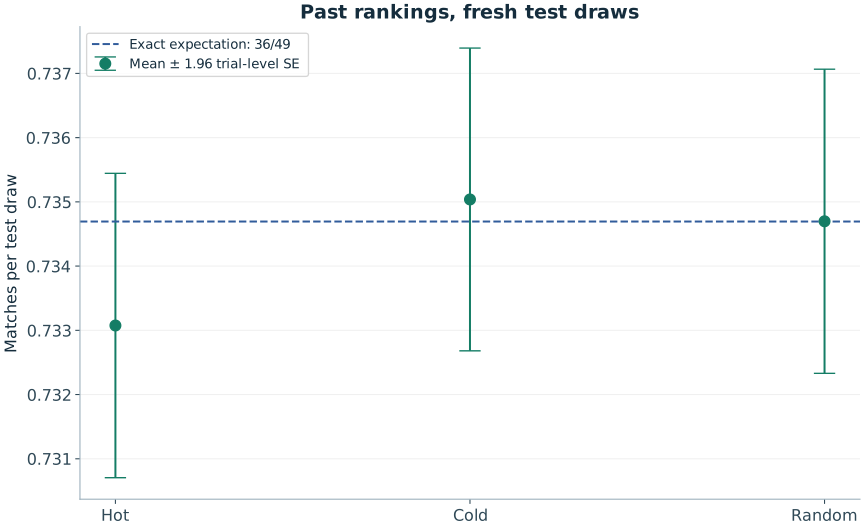
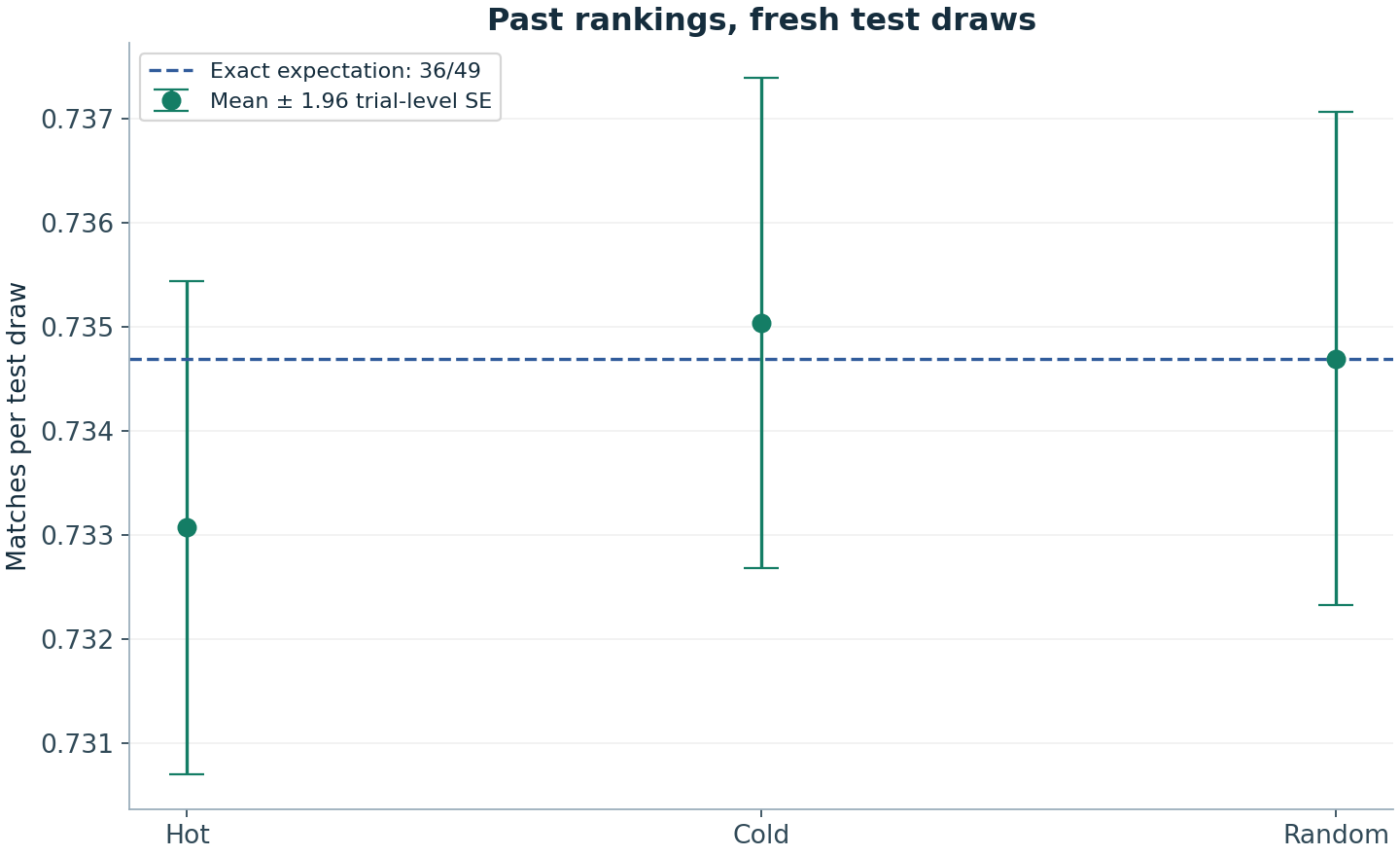
The claim can still be tested: define the rule in advance, freeze it, and measure performance on fresh draws. Our hot-versus-cold experiment uses separate training and test blocks for that reason. The theoretical benchmark is simpler: any six-number set selected using only the past has expected 36/49 matches against a fresh uniform 6/49 draw. A more elaborate history does not alter that conditional expectation.
The overlap calculator explores a different, often surprising result: independent complete draws can share several numbers. Independence forbids a predictive influence; it does not forbid a repeated outcome.
Leave the selection to chance
If you want a valid random game line, open the relevant generator. A generated line is not an official entry or a prediction, and it does not improve the probability of a specified valid combination.
Sources and further reading
The worked examples and derivations are RoomForChance explanations. Operator sources establish game parameters; research sources support the specific points identified above. University links are references, not endorsements.
- Joe Blitzstein and Jessica Hwang · Harvard Stat 110 / Introduction to ProbabilityUniversity-level further reading on counting, conditioning and probability models.
Continue the argument
The Gambler’s Fallacy: Why a Number Does Not Become Due
A mathematical explanation of the gambler’s fallacy, separating an unlikely past streak from the unchanged probability of the next independent event.
With vs Without Replacement: The Probability Difference
Understand how replacing a drawn item changes independence, duplicate possibilities and the formulas used for lottery and digit games.
Do Hot and Cold Lottery Numbers Work? A Holdout Test
Examine hot and cold selection rules using conditional probability and an original experiment with separate training and test draws.