
The gambler's fallacy is the belief that an independent random process must soon compensate for its recent results. After many heads, tails feels due. After a lottery number has been absent for weeks, its return feels overdue. The intuition treats long-run balance as an obligation that the next event must fulfil.
In a fair independent model, there is no such obligation. The probability of the next result is determined by the mechanism, not by how unsatisfying the recent record looks.
Separate the whole streak from its next step Before ten fair coin tosses, ten heads have probability 1/1,024. After nine heads have already occurred, the chance of one more is one half. The first question includes the uncertainty of all ten tosses. The second conditions on nine known outcomes and includes only the remaining uncertainty.
Confusing these questions makes an ordinary conditional probability feel paradoxical. Nothing became more likely retroactively; the event being calculated changed.
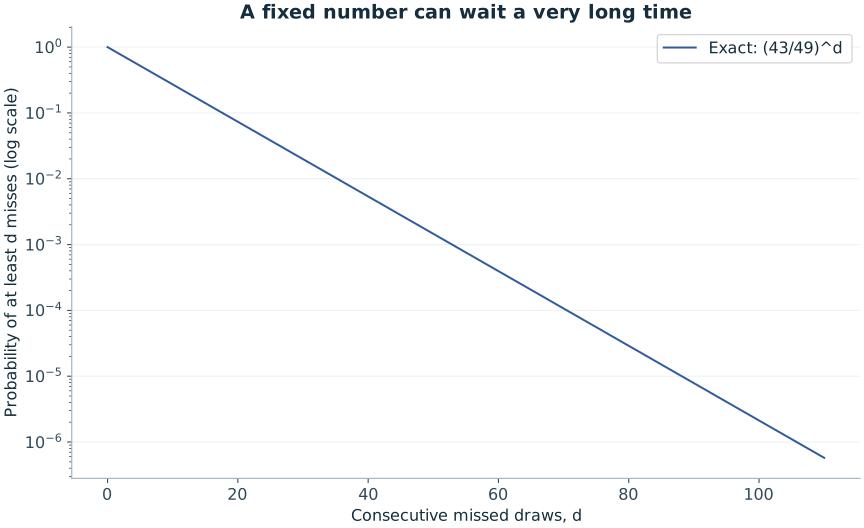
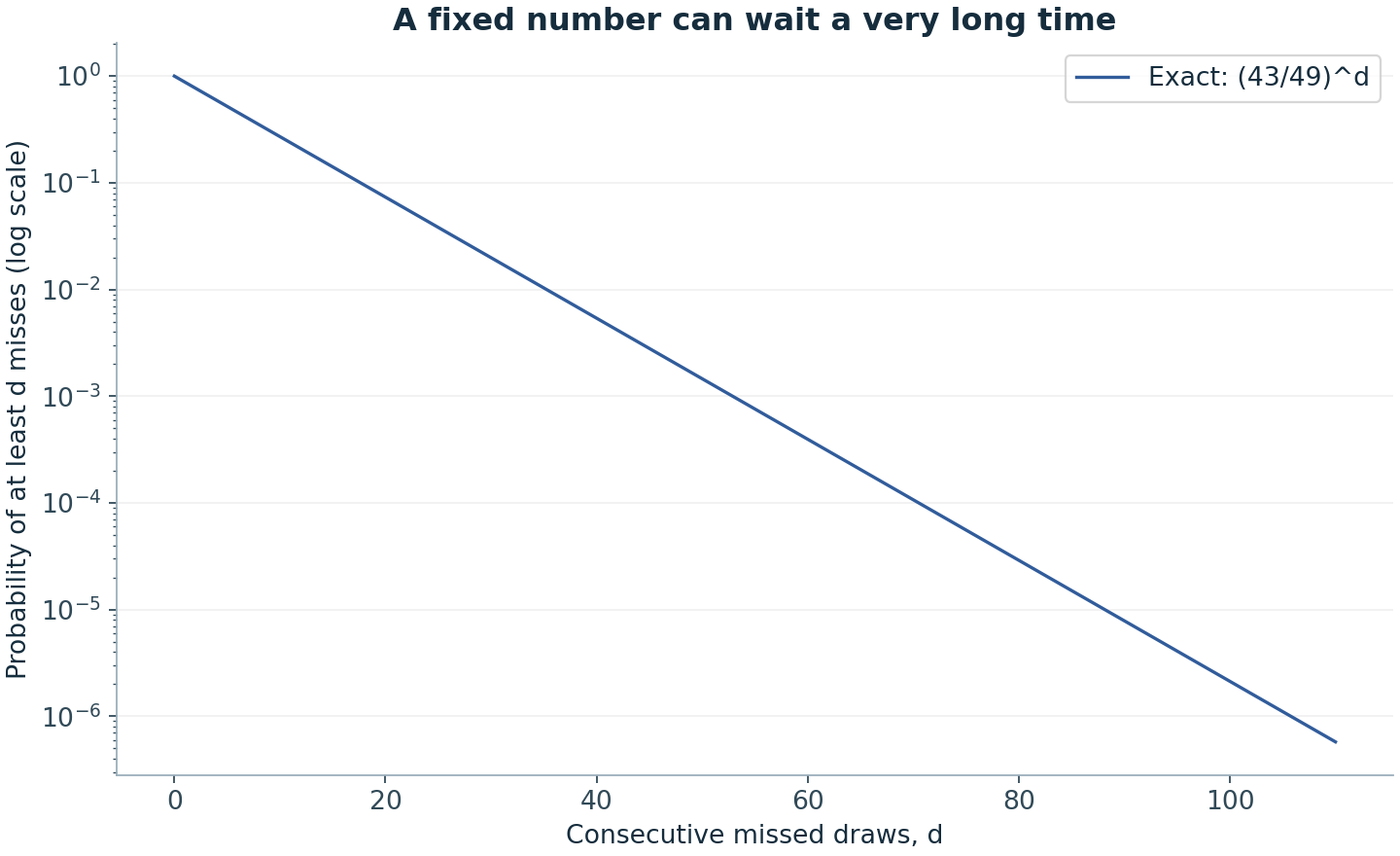
The lottery version For one specified number in a uniform 6/49 draw, p = 6/49. Missing 20 independent draws has probability (43/49)^20. Conditional on that absence, the probability of appearing next remains 6/49.
If you search all 49 numbers and select the most overdue one, you have changed which number you discuss, but you have not changed the future uniform draw. Given the entire past, the chosen label is simply a specified label for the next draw. Its conditional inclusion probability is still 6/49.
Why the law of large numbers does not rescue the intuition Suppose the first 100 fair coin tosses contain 60 heads. The expected count in the next 900 is 450. The expected total is 510 out of 1,000, or 51%. The relative imbalance shrinks without any compensating bias toward tails.
The past excess of ten heads is diluted by a much larger future sample. It is not repaid. A process that deliberately favoured tails to cancel the excess would no longer be an independent fair coin.
When history can matter Not every real-world process is independent. Cards dealt without replacement, changing weather conditions, machine faults and human skill can produce dependencies. Rejecting the gambler's fallacy does not require pretending that all histories are irrelevant. It requires identifying the actual mechanism connecting past and future.
If a lottery's equipment or rules change, analyse the new situation. If the only argument is that a label has waited long enough, the missing causal or statistical connection has not been supplied.
Turn the intuition into a testable claim Define “overdue” before examining future data. Freeze the selection rule. Compare it with an appropriate baseline on fresh outcomes, accounting for any repeated testing. Our holdout experiment applies that logic to hot and cold sets; the gap experiment shows how long absences occur in a model with no compensating force.
The practical benefit is not merely winning an argument about probability. It is recognizing the moment when disappointment starts masquerading as evidence. A result can feel overdue while its probability remains unchanged. No additional purchase is mathematically required to make the record fair.
Leave the selection to chance
If you want a valid random game line, open the relevant generator. A generated line is not an official entry or a prediction, and it does not improve the probability of a specified valid combination.
Sources and further reading
The worked examples and derivations are RoomForChance explanations. Operator sources establish game parameters; research sources support the specific points identified above. University links are references, not endorsements.
- Joe Blitzstein and Jessica Hwang · Harvard Stat 110 / Introduction to ProbabilityUniversity-level further reading on counting, conditioning and probability models.
Continue the argument
Are Overdue Lottery Numbers More Likely to Be Drawn?
Calculate the probability of long absences, understand geometric waiting times, and distinguish a fixed number from the most overdue number.
The Law of Large Numbers Does Not Make a Losing Number Due
See how sample proportions stabilize without future compensation, and why absolute deviations can grow while relative errors shrink.
Independent Events: Why a Fair Draw Has No Memory
Learn conditional probability with coins and lottery draws, including why balls within one draw are dependent while separate draws can be independent.