
An overdue lottery number is one that has not appeared for some chosen length of time. Under independent uniform draws, that absence does not increase its next-draw probability. The word “overdue” is a historical label, not a mathematical debt.
For a specified label in a 6/49 draw, the chance of appearing is p = 6/49 and the chance of missing is q = 43/49. Those two values explain both ordinary waits and surprisingly long ones.
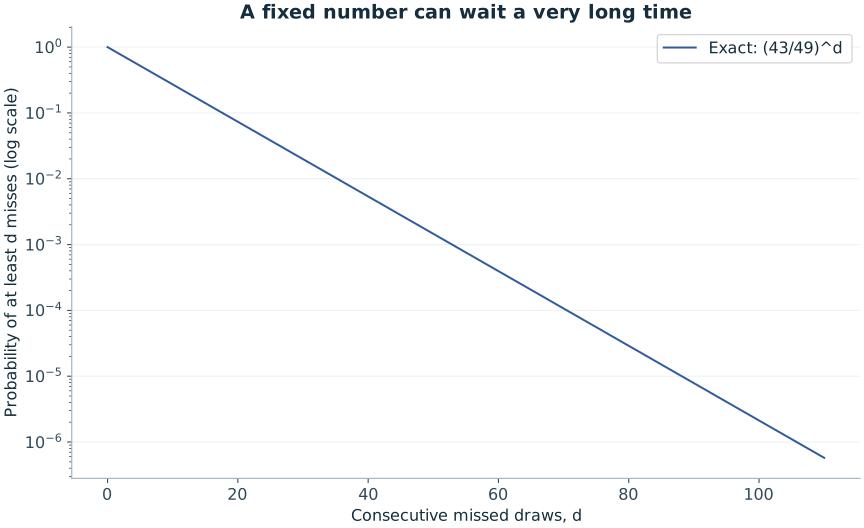
The probability of an absence The chance of missing d consecutive independent draws is q^d. This is the survival probability for a wait: the probability that the wait has lasted at least that many misses. It declines with d, but never becomes exactly zero for a finite d when q is positive.
The chance of exactly d misses followed by an appearance is q^d p. That is a different event from “at least d misses”. A chart should state which one it displays.
Average waiting time has two conventions If waiting time includes the successful draw, its mean is 1/p = 49/6, about 8.17 draws. If it counts only misses before success, its mean is q/p = 43/6, about 7.17 misses. Both are correct, but mixing the conventions creates an off-by-one error.
Neither average is a deadline. The distribution has a long right tail. A number can remain absent far longer than the average without violating the model.
The memoryless calculation Given that the number has already missed d draws, the chance it misses another s is q^(d+s)/q^d = q^s. The earlier wait cancels. In particular, the chance of appearing on the next draw remains p.
That is the precise meaning of memorylessness here. It does not say the earlier absence was typical. It says the remaining wait, under this model, has the same distribution as a fresh wait.
What our million-wait experiment found The Lab generated one million complete independent waits for a prespecified label. The mean number of misses was 7.15402, close to the theoretical 7.16667. The longest observed wait was 110 misses. That maximum was selected from a million opportunities; it is not the expected wait for the next number you inspect.
We used complete geometric waits to avoid a common measurement problem. In a finite historical record, an absence continuing at the end has not finished. Treating it as a completed short wait biases the summary. Such observations are right-censored and need appropriate handling.
A fixed number is not the worst of 49 Looking at all labels and reporting the longest current absence changes the statistic. The labels' histories within each draw are dependent, so the maximum across labels is not simply 49 independent geometric waits. Our tool calculates a fixed-label absence, and the experiment states that scope explicitly.
Use an overdue table to understand what has happened, if you find it interesting. Do not let its dramatic longest gap become a claim that the next draw owes a return. The mechanism, not the age of the absence, determines the probability.
Leave the selection to chance
If you want a valid random game line, open the relevant generator. A generated line is not an official entry or a prediction, and it does not improve the probability of a specified valid combination.
Sources and further reading
The worked examples and derivations are RoomForChance explanations. Operator sources establish game parameters; research sources support the specific points identified above. University links are references, not endorsements.
- Joe Blitzstein and Jessica Hwang · Harvard Stat 110 / Introduction to ProbabilityUniversity-level further reading on counting, conditioning and probability models.
Continue the argument
The Gambler’s Fallacy: Why a Number Does Not Become Due
A mathematical explanation of the gambler’s fallacy, separating an unlikely past streak from the unchanged probability of the next independent event.
Why Randomness Creates Streaks, Clusters and Repetitions
Understand random streaks using fixed windows, overlapping opportunities and a clear distinction between a specified run and any run.
Why Rare Events Happen: Probability Needs an Opportunity Count
Learn the difference between one rare event, at least one occurrence and a surprise found after searching many opportunities.