
A probability can be tiny without making an event impossible. More subtly, an event that is rare in one trial can be likely across many trials. To evaluate a surprising story, you need both the probability per opportunity and the number of opportunities that existed.
The complement is easier to count If an event has probability p on each of N independent trials, the probability of no occurrence is (1−p)^N. Therefore the probability of at least one occurrence is 1−(1−p)^N. For small p and moderate Np, this is approximately 1−exp(−Np).
Consider an event with probability one in 1,000 per trial. After 1,000 independent trials, the probability of at least one occurrence is about 63.2%, not 100%. “One in a thousand” is not a guarantee that every block of a thousand contains one success. Some blocks contain none; some contain several.
Expected count is not a promise The expected number of occurrences is Np. When N = 1/p, that expectation is one. An expectation is a weighted average over possible outcomes. It can equal one while a substantial fraction of records contain no successes at all.
This matters especially for jackpot simulations. In one million uniform 6/49 draws, a particular combination has expected count about 0.0715. Most such simulations contain no occurrence of that combination. A graph comparing two specified jackpot combinations can therefore show two zeros without providing meaningful empirical evidence that their probabilities are equal. Counting the outcome space establishes equality much more directly.
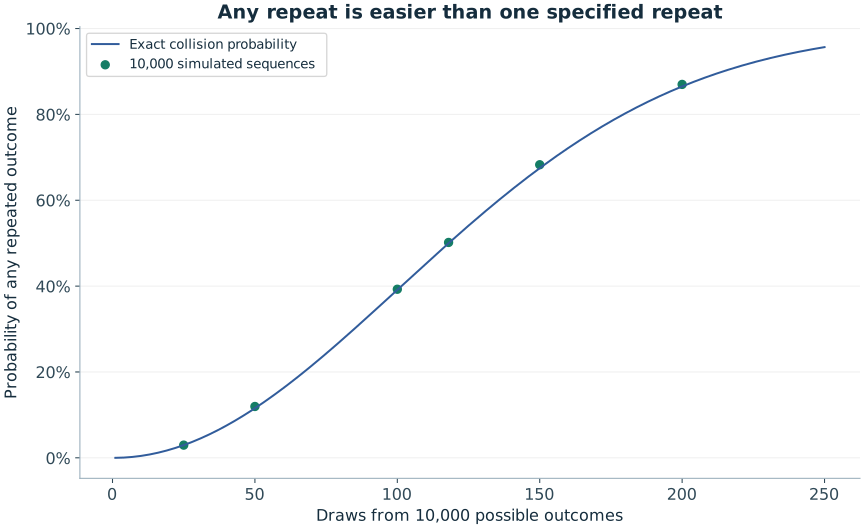
The story may have been chosen after the event Suppose a lottery draw is unusual because all its numbers share an ending. Another is unusual because the sum is small. A third resembles a date. If we inspect enough draws and permit enough definitions of unusual, we should expect to find material for a surprising headline.
The probability of the particular description selected afterwards is not automatically the probability of encountering something we would have called surprising. That broader event is difficult to define, which is precisely why retrospective astonishment should be handled cautiously.
Rare does not automatically mean meaningful The probability of any exact long sequence of coin tosses is extremely small. Nevertheless, some exact sequence must occur. Its small probability cannot, by itself, distinguish fair randomness from another explanation. To compare explanations, identify evidence that one mechanism makes more likely than the other and account for how that evidence was selected.
Our birthday-collision experiment illustrates how opportunities multiply even within one record. The multiple-testing experiment shows a related effect when many statistical alarms are inspected. Neither means that all anomalies should be dismissed; both mean that an anomaly must be measured against an appropriate reference question.
When reading “the odds were astronomical”, ask: odds of what, specified when, across how many opportunities, and under which model? Those four questions often reveal whether the story contains a genuine statistical puzzle or simply a rare event that had plenty of chances to occur.
Leave the selection to chance
If you want a valid random game line, open the relevant generator. A generated line is not an official entry or a prediction, and it does not improve the probability of a specified valid combination.
Sources and further reading
The worked examples and derivations are RoomForChance explanations. Operator sources establish game parameters; research sources support the specific points identified above. University links are references, not endorsements.
- Joe Blitzstein and Jessica Hwang · Harvard Stat 110 / Introduction to ProbabilityUniversity-level further reading on counting, conditioning and probability models.
Continue the argument
The Birthday Paradox in Lottery Draws: Any Repeat vs One Repeat
Why any repeated combination becomes plausible much sooner than a chosen combination returning, with exact and approximate collision formulas.
Multiple Comparisons: Why Random Data Keeps Producing “Signals”
Calculate how repeated testing creates false alarms and learn why a pattern found after a broad search needs a different interpretation.
Monte Carlo Simulation: Learn Probability by Repeating the Model
Build a trustworthy probability simulation with a defined event, reproducible generator, uncertainty estimate and exact benchmark where available.