
The birthday paradox is an opportunity-counting effect. A match between any pair in a group has many chances to occur. In a lottery with M equally likely complete outcomes, the next draw matching one specified past outcome has probability 1/M. A repeated outcome somewhere among t draws involves t(t−1)/2 possible pairs.
The word “any” changes the question dramatically.
Count no collision first Assume independent draws with replacement from M possible outcomes. The first draw is unrestricted. To avoid a repeat, the second must differ from it, with probability (M−1)/M. The third must avoid two previous outcomes, with probability (M−2)/M.
For t no greater than M, the no-repeat probability is the product over j = 0 through t−1 of (1−j/M). Subtract this product from one for the probability of at least one repeated outcome. If t exceeds M, a repeat is certain by the pigeonhole principle.
The square-root scale When t is small relative to M, the collision probability is approximately 1−exp[−t(t−1)/(2M)]. Setting this near one half gives t ≈ √(2M ln 2). The threshold grows roughly with √M, not M.
For M = 10,000, the approximation places the halfway point near 118 draws. Our reduced-space experiment used 10,000 independent sequences and found a median first-repeat time of 118. It also compares observed collision proportions at several sample lengths with the exact product.
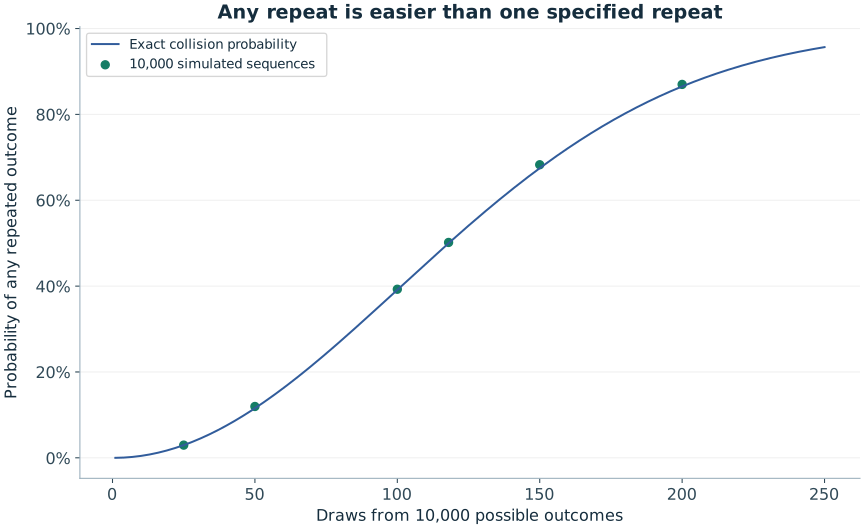
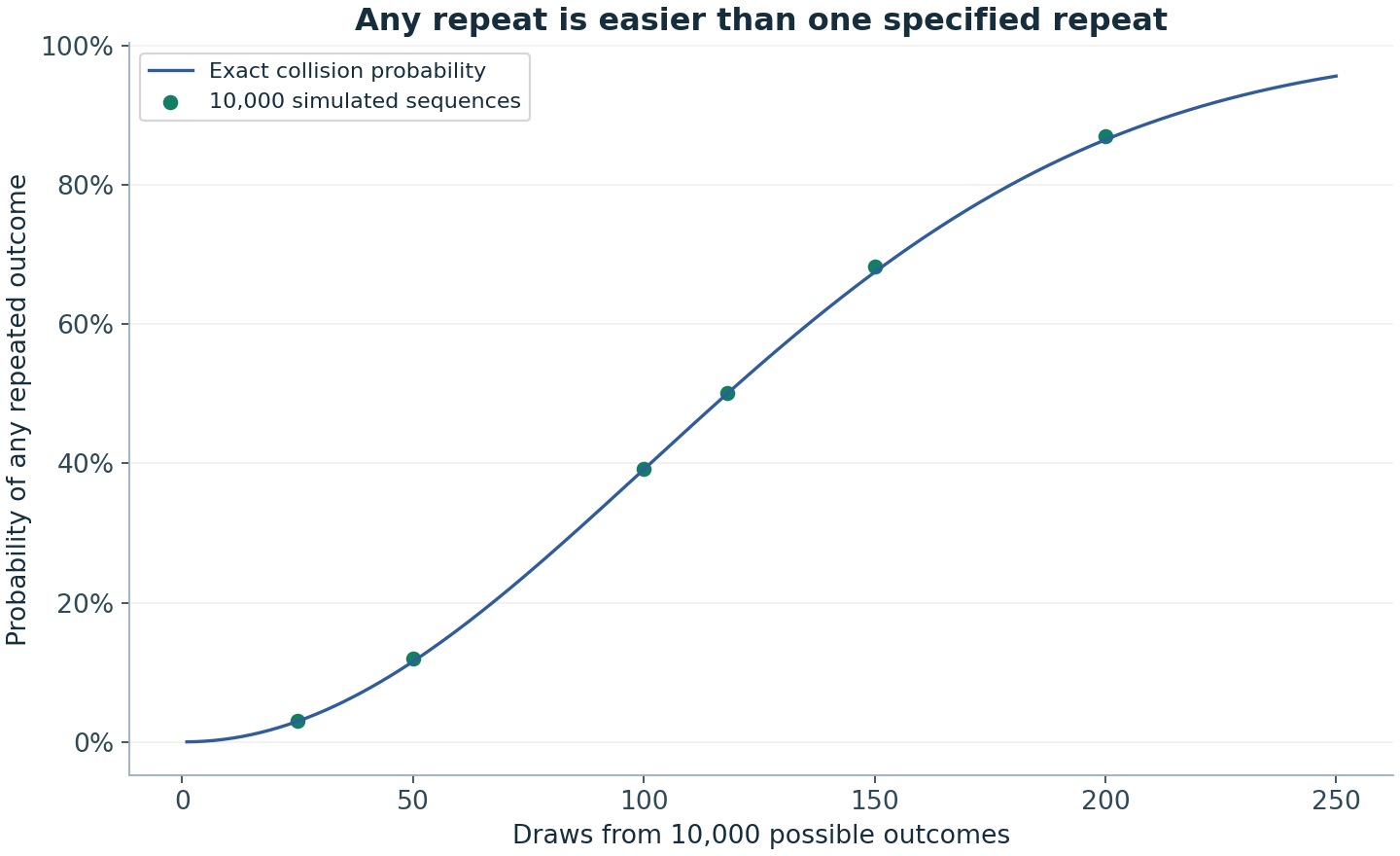
Why this does not make your chosen line due The first repeat can be any of thousands of previously observed outcomes. Waiting for one predetermined line asks for a much narrower event. Its waiting time has mean M under independent uniform draws.
The birthday effect does not increase the next-draw probability of a label or line you have selected. It increases the number of acceptable matching pairs in the question you are asking.
Historical headlines need this distinction If a report searches many years, several games and multiple rule eras for repeated combinations, it must state the search space. The single-pair probability is not the probability of finding any repeat across that entire search.
Rule changes matter too. A 6/49 outcome space and a 6/59 outcome space are different models. Combining their records without accounting for the change can invalidate a simple uniform-collision calculation.
Exact arithmetic and stable computation Multiplying many terms close to one can lose numerical precision. Summing log(1−j/M) and converting back with an appropriate exponential function is more stable. The published code uses this approach for the exact reduced-space reference values.
The experiment is intentionally small enough for repeats to be visible and for the result to be reproduced quickly. It is not presented as a historical lottery dataset or a prediction about a particular game's next collision. Its contribution is conceptual: before reacting to a repeated outcome, identify how many possible pairs were allowed to supply the surprise.
Leave the selection to chance
If you want a valid random game line, open the relevant generator. A generated line is not an official entry or a prediction, and it does not improve the probability of a specified valid combination.
Sources and further reading
The worked examples and derivations are RoomForChance explanations. Operator sources establish game parameters; research sources support the specific points identified above. University links are references, not endorsements.
- Joe Blitzstein and Jessica Hwang · Harvard Stat 110 / Introduction to ProbabilityUniversity-level further reading on counting, conditioning and probability models.
Continue the argument
Why Rare Events Happen: Probability Needs an Opportunity Count
Learn the difference between one rare event, at least one occurrence and a surprise found after searching many opportunities.
Can Lottery Numbers Repeat? Three Different Questions
Repeated balls, repeated numbers across draws and repeated complete combinations follow different probability rules. See the exact distinctions.
Multiple Comparisons: Why Random Data Keeps Producing “Signals”
Calculate how repeated testing creates false alarms and learn why a pattern found after a broad search needs a different interpretation.