
Yes, lottery numbers can repeat across independent draws. Whether they can repeat within one draw depends on the game. And an entire winning combination can recur when the rules permit the same outcome on each occasion. These are three different events, so they require three different calculations.
Repetition inside one number pool In a standard lottery that selects six distinct balls from 49 without replacement, the same ball cannot appear twice during that extraction. A generator for that game should therefore produce six different main numbers. But a separate bonus pool is a different pool: a main number and a separately selected bonus number can share the same numerical label without representing the same ball.
For example, a main ball labelled 7 and a separate special ball labelled 7 do not violate a no-duplicates rule within either pool. A generator that removes the special label from the main pool would silently change the game.
Repetition between complete draws For one specified label in independent uniform 6/49 draws, the chance of appearing next time is 6/49. Its previous appearance does not remove it permanently. The pool is restored between draws.
For two complete draws, the expected number of shared labels is 36/49, about 0.735. To see why, fix the first set. Each of its six labels has probability 6/49 of appearing in the second. Add those six probabilities. This expectation can be less than one even though a shared label occurs quite often; expectation and the probability of any overlap are different quantities.
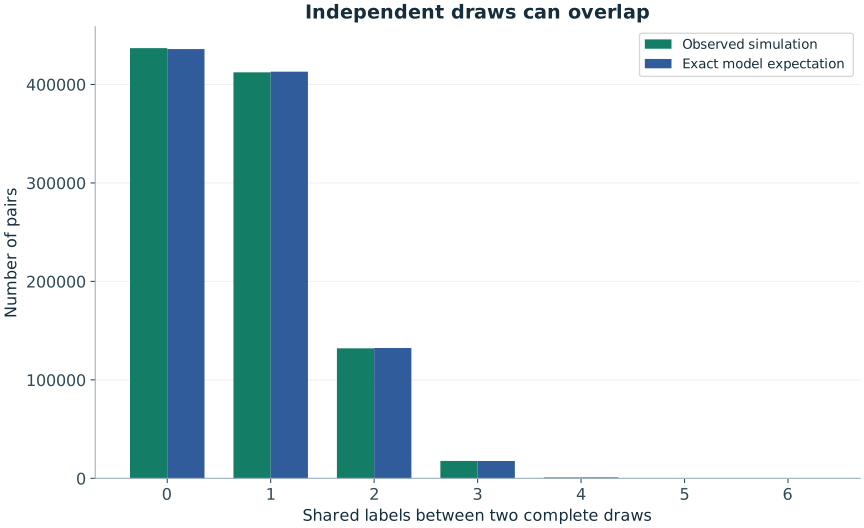
The exact probability of r shared numbers is C(6,r)C(43,6−r)/C(49,6). The overlap calculator shows the complete distribution, including zero and full overlap.
Repetition of the entire combination Once the first 6/49 set is known, the chance that the next draw matches it exactly is 1/13,983,816. The set is one possible outcome among all valid sets. Its status as a previous winner gives it neither a penalty nor a bonus.
Now change the question to “Will any two draws match somewhere in a long record?” There are many pairs of draws to compare. That produces the birthday effect: any repeat typically becomes plausible much sooner than the return of one particular chosen combination. Quoting the one-pair probability for an entire historical search understates the number of opportunities.
What this means when selecting numbers Excluding last week's winners removes valid combinations from your own selection process. It does not remove them from the lottery machine. Keeping last week's exact line does not give it an advantage either. Under a uniform independent model, the probability of the line you actually submit remains the same.
Our repetition experiment uses one million independent pairs of synthetic draws and compares observed overlap counts with the exact formula. It is designed to show the distribution clearly, not to imply that a rare full repeat should appear on demand. Some theoretically possible categories may have zero observations in a finite simulation. Zero observations are not the same thing as zero probability.
Leave the selection to chance
If you want a valid random game line, open the relevant generator. A generated line is not an official entry or a prediction, and it does not improve the probability of a specified valid combination.
Sources and further reading
The worked examples and derivations are RoomForChance explanations. Operator sources establish game parameters; research sources support the specific points identified above. University links are references, not endorsements.
- Joe Blitzstein and Jessica Hwang · Harvard Stat 110 / Introduction to ProbabilityUniversity-level further reading on counting, conditioning and probability models.
Continue the argument
How Often Do Lottery Numbers Repeat Between Draws?
Use the hypergeometric distribution to calculate shared labels between independent draws, including zero overlap and four repeated numbers.
The Birthday Paradox in Lottery Draws: Any Repeat vs One Repeat
Why any repeated combination becomes plausible much sooner than a chosen combination returning, with exact and approximate collision formulas.
With vs Without Replacement: The Probability Difference
Understand how replacing a drawn item changes independence, duplicate possibilities and the formulas used for lottery and digit games.