
Independent lottery draws can share numbers. Independence means the first draw does not change the second draw's probabilities; it does not mean the second draw must avoid the first. In a uniform 6/49 model, the expected overlap is 36/49 labels, and the full overlap distribution follows a simple counting formula.
Fix the first draw Once the first set is known, mark its six labels. A second draw with exactly r repeated labels chooses r from the marked six and 6−r from the other 43. The probability is C(6,r)C(43,6−r)/C(49,6).
This is the same calculation as matching a fixed lottery ticket against a fresh draw. The identities of the first six labels are irrelevant under a uniform model; only the set size matters.
Zero overlap and at least one repeat No shared labels means all six new labels come from the 43 outside the first set. Its probability is C(43,6)/C(49,6). Therefore at least one repeat has probability 1−C(43,6)/C(49,6).
The expected overlap, 36/49, is not this probability. It is the average number of shared labels, counting two repeats as two and three as three. Confusing an expected count with an occurrence probability can yield the wrong interpretation even when both numbers are between zero and one.
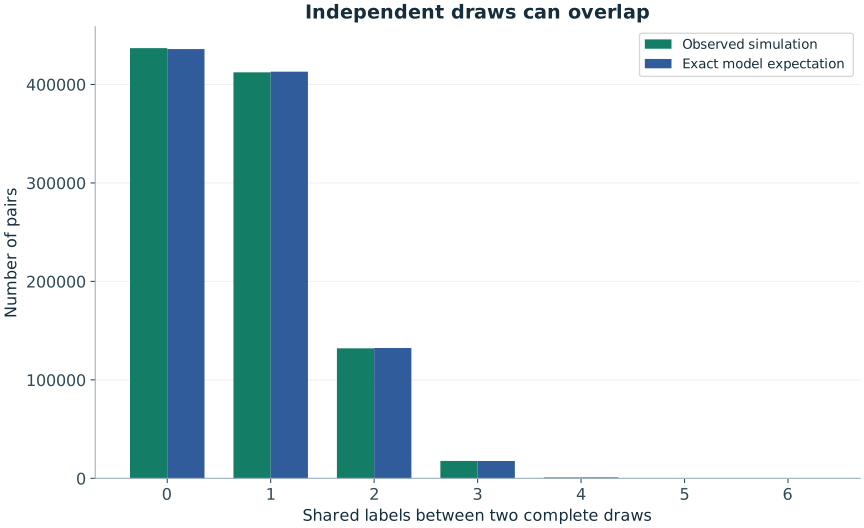
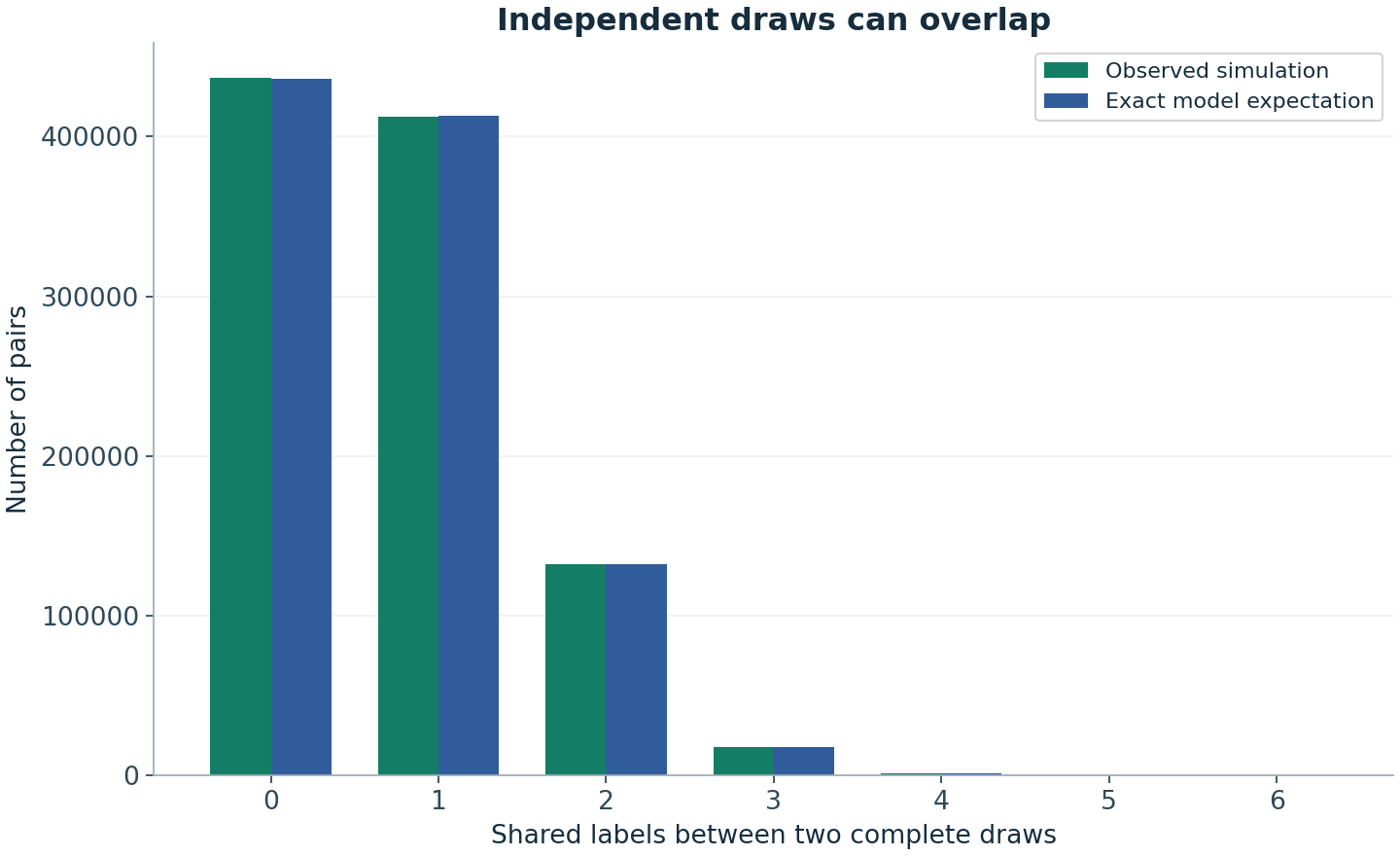
Four repeats are possible Exactly four shared labels have probability C(6,4)C(43,2)/C(49,6). The numerator chooses which four return and which two newcomers fill the line. Five repeats and six repeats have their own categories.
A full repeat has probability 1/C(49,6) for a specified pair of draws. Searching an entire historical archive for any repeated pair is a different birthday-collision question with many opportunities.
A clean experiment uses disjoint pairs Our Lab generated one million independent pairs of synthetic 6/49 draws and counted their intersections. The mean overlap was 0.733503, compared with the exact 36/49 ≈ 0.734694. The downloadable table includes all categories from zero through six.
Using disjoint pairs makes the experimental units clearly separate. When working with a historical record, adjacent comparisons reuse draws, so the analyst should examine the dependence structure of the statistic before choosing uncertainty calculations. The right design should be explicit rather than assumed from a familiar formula.
What this means for selecting a line Avoiding every label drawn last time does not mirror the behaviour of independent draws. It imposes a restriction on your choice that the next draw does not have. Reusing some labels is not an advantage either. Both choices lead to a specified valid set with the same full-match probability.
The overlap calculator presents exact probabilities and expected counts so these questions can be explored without a simulation. The Lab then provides an empirical illustration of those formulas. Together they show why a repeated number is usually a feature to understand, not evidence that the mechanism remembers its previous result.
Leave the selection to chance
If you want a valid random game line, open the relevant generator. A generated line is not an official entry or a prediction, and it does not improve the probability of a specified valid combination.
Sources and further reading
The worked examples and derivations are RoomForChance explanations. Operator sources establish game parameters; research sources support the specific points identified above. University links are references, not endorsements.
- Joe Blitzstein and Jessica Hwang · Harvard Stat 110 / Introduction to ProbabilityUniversity-level further reading on counting, conditioning and probability models.
Continue the argument
Can Lottery Numbers Repeat? Three Different Questions
Repeated balls, repeated numbers across draws and repeated complete combinations follow different probability rules. See the exact distinctions.
How to Calculate the Probability of Matching Lottery Numbers
Derive the hypergeometric formula for exactly r matches and distinguish exact, at-least and separate-pool matching events.
The Birthday Paradox in Lottery Draws: Any Repeat vs One Repeat
Why any repeated combination becomes plausible much sooner than a chosen combination returning, with exact and approximate collision formulas.