
More distinct full-match lines in the same uniform lottery draw cover more possible winning combinations. If the game has M possible full combinations and you hold m distinct ones, the jackpot-match probability is m/M. The improvement is real, but its size must be understood in absolute terms, and duplicate lines do not add new combinations.
Why the one-draw calculation is linear Only one full combination wins in the simplified model. Different specified full-match lines correspond to mutually exclusive winning outcomes: the draw cannot equal two different combinations at once. Adding their probabilities therefore gives m/M, up to complete coverage.
In a generic 6/49 model, M = 13,983,816. Ten distinct lines give probability 10/13,983,816, or roughly one in 1.398 million. A tenfold relative increase still leaves an extremely small probability. It is not a recommendation to spend more.
A duplicate line is the same event twice Two identical lines both match when that one combination appears and both fail otherwise. The probability of at least one matching line remains 1/M. Depending on a game's rules and prize sharing, duplicate tickets can affect a payout conditional on winning, but they do not increase the set of winning combinations covered.
This distinction is especially important when software generates many lines independently: duplicates are possible unless the program also enforces uniqueness across lines. Distinct numbers inside a line and distinct complete lines are separate requirements.
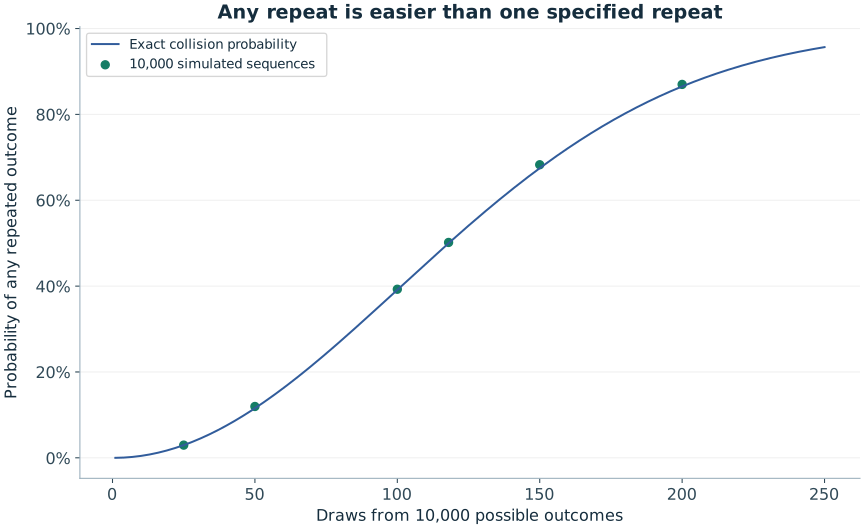
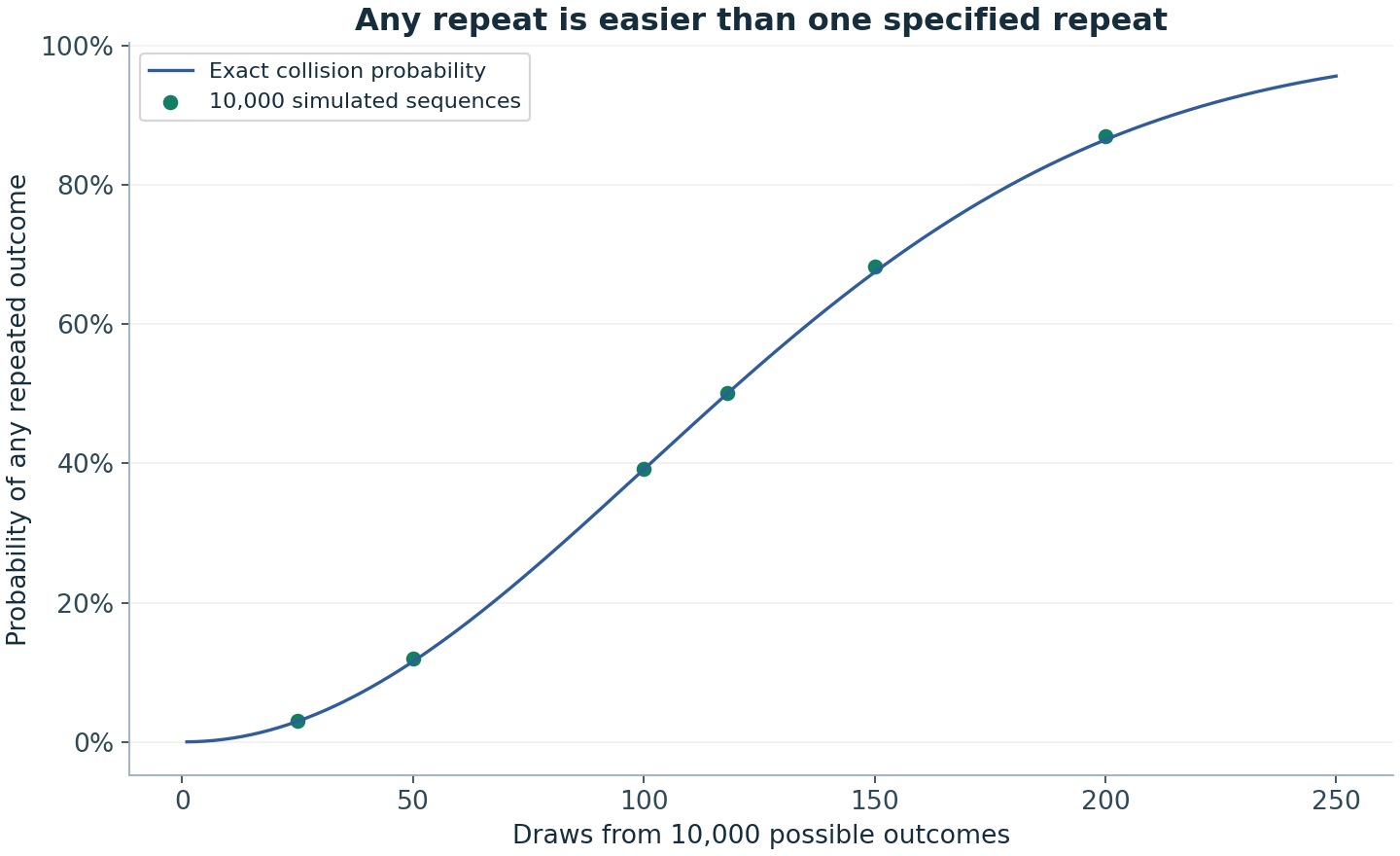
Repeated draws use a different formula Suppose one specified line is used on each of d independent draws. The chance of no match is (1−1/M)^d, so the chance of at least one match is 1−(1−1/M)^d. This is slightly smaller than d/M because multiple successes are possible across different draws, while the at-least-one event counts them only once.
If m distinct lines are used on each of d independent draws, replace 1/M by m/M. The line choices can change between draws without changing this result when each draw remains uniform and independent and the number of distinct lines stays fixed.
Partial prizes complicate portfolio coverage Two different tickets can both receive partial prizes from the same draw. Their partial-win events may overlap, especially if the lines share many labels. You cannot generally add their individual any-prize probabilities to get the probability that at least one ticket wins something.
The simple m/M formula is specifically about distinct full-match combinations in one draw. Our tool labels that scope and does not present it as a universal calculator for every prize tier.
Probability is not profitability Even hypothetical full coverage does not establish a profit. Entry costs, shared prizes, payout structure, logistics and rules matter. A probability of matching is one component of an economic calculation, not a complete conclusion.
Use the calculator to compare scenarios mathematically, including a single-line baseline. The useful lesson is scale: a large relative change in a very small probability can remain very small. An impartial generator can help choose combinations; it cannot remove that scale.
Leave the selection to chance
If you want a valid random game line, open the relevant generator. A generated line is not an official entry or a prediction, and it does not improve the probability of a specified valid combination.
Sources and further reading
The worked examples and derivations are RoomForChance explanations. Operator sources establish game parameters; research sources support the specific points identified above. University links are references, not endorsements.
- Joe Blitzstein and Jessica Hwang · Harvard Stat 110 / Introduction to ProbabilityUniversity-level further reading on counting, conditioning and probability models.
Continue the argument
Probability vs Odds: What Does “1 in a Million” Mean?
Convert probabilities, percentages and odds against correctly, and learn why one-in-X is not a deadline for a rare event.
Why Duplicate Lottery Lines Do Not Increase Coverage
Distinguish repeated labels, repeated full lines and repeated entries across draws, and calculate how duplicates reduce distinct outcome coverage.
How to Calculate the Probability of Matching Lottery Numbers
Derive the hypergeometric formula for exactly r matches and distinguish exact, at-least and separate-pool matching events.