
Two identical lottery lines cover the same complete outcome. In one uniform draw with M possible full combinations, buying or generating the same line twice does not turn its match probability from 1/M into 2/M. The two copies succeed together or fail together.
This statement concerns coverage. Payout treatment for multiple winning tickets is a separate question governed by the game's rules.
Distinct outcomes are what add If m lines represent m different complete combinations, their full-match events in one draw are mutually exclusive and their probabilities sum to m/M. If some lines repeat, replace m with the number of distinct combinations actually represented.
For example, the list A, B, B, C contains four entries but three distinct outcomes. Its probability of at least one full match is 3/M, not 4/M. Counting rows rather than unique outcomes overstates coverage.
Duplicate labels and duplicate lines are different A 6/49 line cannot contain the same main label twice. But two separate correctly generated lines can be identical. A generator that enforces within-line distinctness has not necessarily enforced uniqueness across the entire batch.
Separate special pools complicate comparison: two lines with the same main set but different special labels are different complete outcomes when the special label is part of the top-prize condition. A deduplication routine must compare the full relevant combination, not only the main numbers.
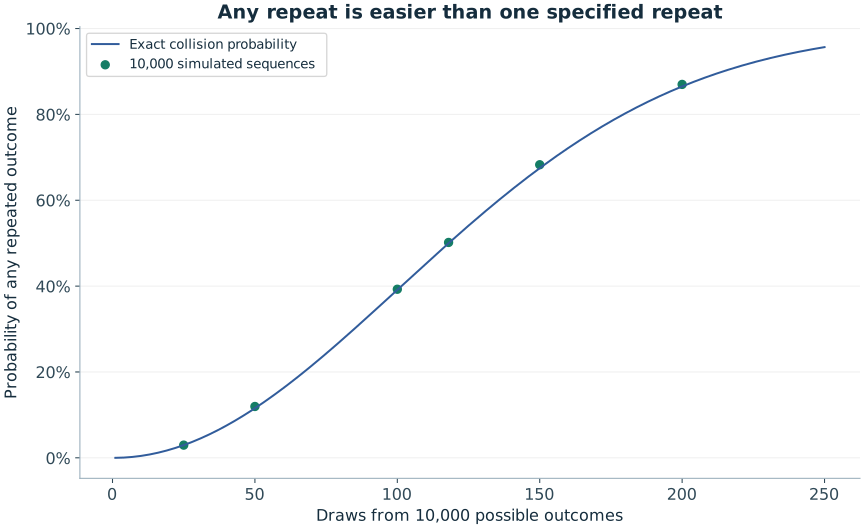
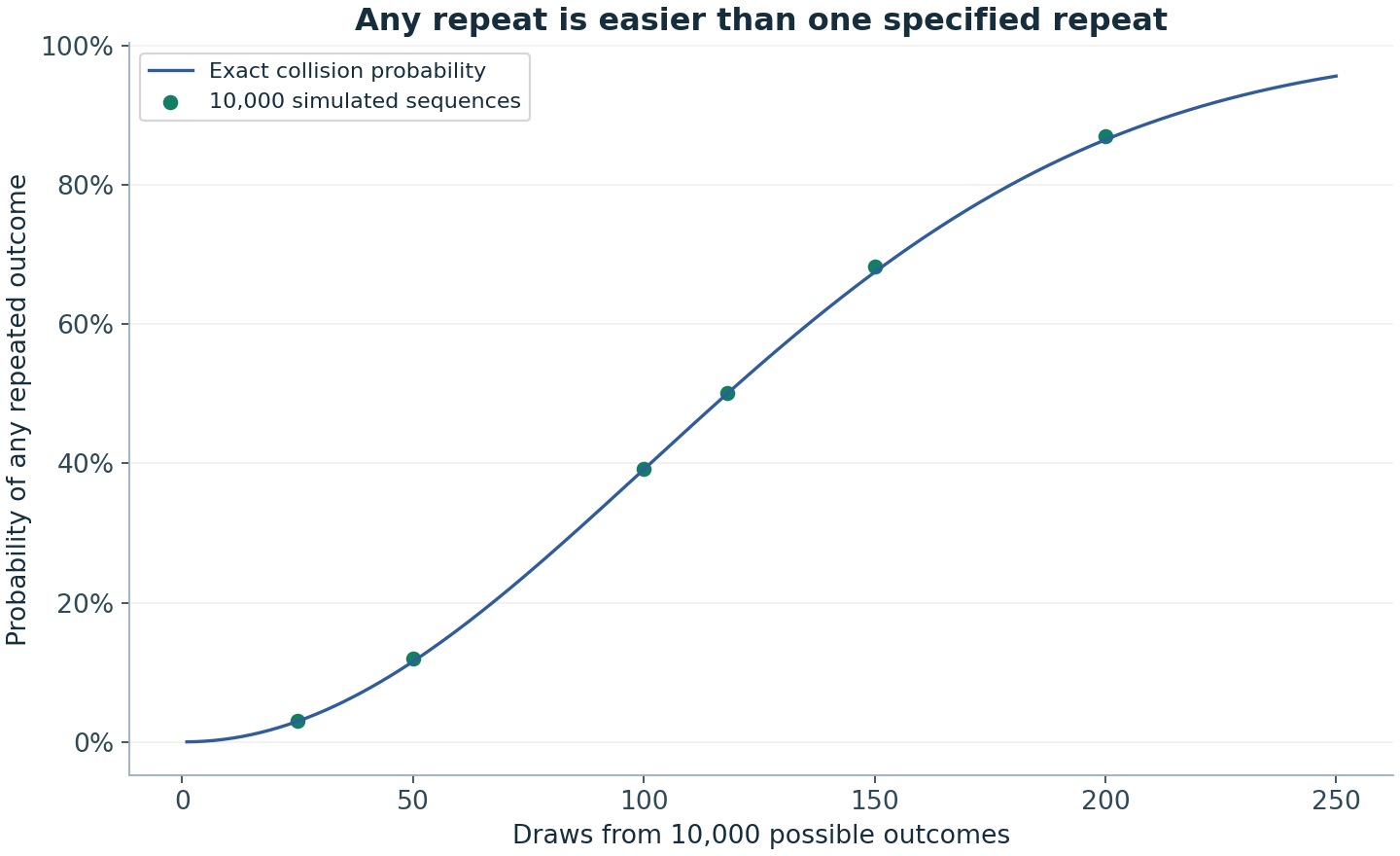
Independent generation naturally allows repeats If t lines are independently sampled uniformly from M outcomes, the expected number of distinct outcomes represented is M[1−(1−1/M)^t]. For each possible outcome, the probability it appears at least once is 1−(1−1/M)^t; add across all M outcomes.
This expectation is at most t. For small batches in a huge outcome space, duplicates are unlikely, but they remain possible. In a tiny demonstration space, repeated lines become visible quickly through the birthday effect.
Repeated draws are a different scenario Using the same line on different independent draws creates new opportunities. After d draws, the probability of at least one full match is 1−(1−1/M)^d. The line itself does not improve with age; the event spans more independent trials.
Changing the line between draws does not change that probability under the same model, provided each chosen line is valid and selected without knowledge of the future result. Repeating a line is neither a guarantee nor a mathematical penalty across independent draws.
A practical way to compare batches Normalize the order within each unordered pool, preserve separate pools, then compare complete lines. Report both total rows and unique combinations. Do not remove duplicates silently if the user needs an exact record of what was originally generated.
The multiple-lines calculator asks for distinct full combinations per draw because that is the quantity its formula uses. The birthday experiment explains why independent batches can contain repeats. Together they keep three separate ideas clear: valid labels within a line, unique outcomes across a batch, and new opportunities across independent draws.
Leave the selection to chance
If you want a valid random game line, open the relevant generator. A generated line is not an official entry or a prediction, and it does not improve the probability of a specified valid combination.
Sources and further reading
The worked examples and derivations are RoomForChance explanations. Operator sources establish game parameters; research sources support the specific points identified above. University links are references, not endorsements.
- Joe Blitzstein and Jessica Hwang · Harvard Stat 110 / Introduction to ProbabilityUniversity-level further reading on counting, conditioning and probability models.
Continue the argument
Do More Lottery Tickets Increase Your Odds? The Exact Mathematics
Compare distinct lines in one draw, duplicate lines and repeated independent draws without confusing relative improvement with a likely win.
The Birthday Paradox in Lottery Draws: Any Repeat vs One Repeat
Why any repeated combination becomes plausible much sooner than a chosen combination returning, with exact and approximate collision formulas.
How to Generate Random Numbers Without Repetition
Learn two fair methods for distinct random numbers, why sorting is safe, and why filtering patterns changes the distribution.