
A birthday-based lottery line is not less likely to be drawn than another specified valid line in a uniform lottery. The meaningful concern is different: if many players choose similar lines and a prize is shared, a winning line may have more co-winners. Probability of winning and the amount received if you win are separate questions.
The draw does not know why you chose a label In a 6/49 model, any particular six-number set has probability 1/13,983,816. A set entirely below 32 and a set containing larger labels each occupy one place in that outcome space. Personal meaning does not alter the count.
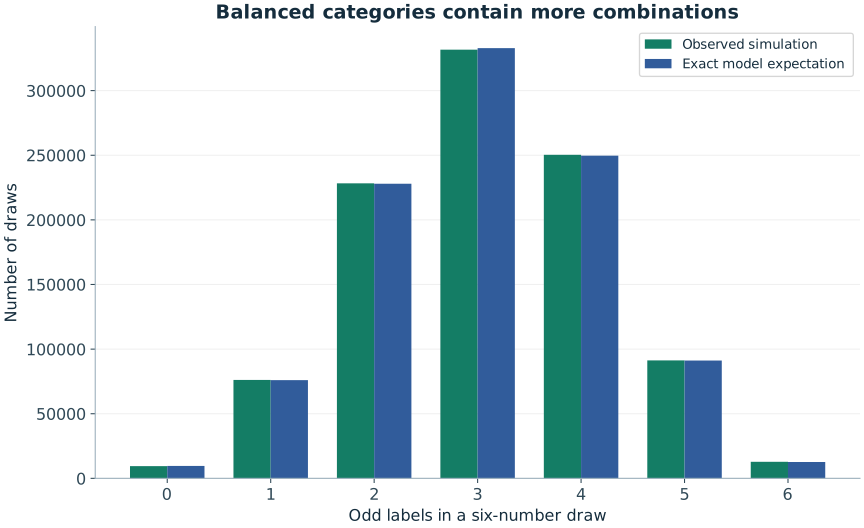
The category “all six labels are at most 31” contains C(31,6) sets. Its probability is C(31,6)/C(49,6). This category probability is not the probability of your single birthday line. Treating a large category as if it were a ticket repeats the same error seen in odd/even advice.
Sharing depends on a second distribution Let J be a shared jackpot and W the number of other winning entries when your line wins. In a simple equal-share model, your share is J/(W+1). The draw model determines whether your line wins. Other players' choices influence W conditional on that event.
Even if two lines have the same winning probability, they can have different conditional sharing distributions. Establishing those distributions requires actual choice data and the game's rules. A general observation that birthdays are popular is not enough to calculate a specific current expected payout.
What empirical research can tell us Research on lottery number preferences provides evidence that people do not always choose uniformly. That supports studying selection behaviour as its own subject. It does not justify claiming that a particular unusual line is guaranteed to be unshared, or that avoiding all dates makes a purchase profitable.
The OLG explanation of pari-mutuel prizes also makes clear that multiple winning selections divide a prize pool. That is a rule about allocation after a winning outcome, not a rule that changes which numbers are drawn.
Why “avoid birthdays” can be overstated Some people select dates; others select patterns, culturally meaningful labels or random lines. Preferences vary across games, countries and time. Other players can also follow advice to avoid birthdays. Without representative current data, the size of any sharing difference remains uncertain.
A line can look unusual to you and still be popular for a reason you have not considered. Conversely, a familiar-looking line is not automatically the most popular combination in the market.
What remains useful Keep the two questions separate: “What is the chance this line matches?” and “What happens to the prize if other entries also match?” The first has an exact answer under a uniform model. The second depends on behaviour and payout conditions.
An impartial generator can help you avoid restricting yourself to personally meaningful labels. Its value is an uncomplicated selection process. It does not certify that nobody else chose the same line, improve the line's draw probability or turn a lottery into a financial strategy.
Leave the selection to chance
If you want a valid random game line, open the relevant generator. A generated line is not an official entry or a prediction, and it does not improve the probability of a specified valid combination.
Sources and further reading
The worked examples and derivations are RoomForChance explanations. Operator sources establish game parameters; research sources support the specific points identified above. University links are references, not endorsements.
- OLG · LOTTO 6/49 odds and payoutsDistinguishes Classic Draw tiers, Gold Ball Draw probabilities and prize sharing; checked 22 September 2026.
- Joe Blitzstein and Jessica Hwang · Harvard Stat 110 / Introduction to ProbabilityUniversity-level further reading on counting, conditioning and probability models.
Continue the argument
Quick Pick vs Choosing Your Own Numbers: Does Either Have Better Odds?
Compare Quick Pick, Lucky Dip and personal selections while separating draw probability, winner counts and possible prize sharing.
Why Humans Do Not Choose Numbers Randomly
Explore the difference between human selection and uniform sampling, with research on number preferences and a measurable coin-sequence example.
Is 1-2-3-4-5-6 as Likely as Any Other Lottery Combination?
Yes under a uniform 6/49 model. Understand why a specific ordered-looking line differs from the broad category of all consecutive sets.