
For a valid specified line in a uniform lottery draw, the jackpot-match probability does not depend on whether a person chose it or a random generator supplied it. Quick Pick and the UK term Lucky Dip describe selection methods. They do not add a new force to the draw.
There are still meaningful differences in convenience and in how selections are distributed across players. Those differences should not be confused with a higher probability for the line itself.
Why a winner percentage is not enough Suppose, as a hypothetical example, 80% of entries use automatic selection and 80% of winning entries do too. That is consistent with equal per-entry success rates. The larger group supplies more winners because it supplies more entries.
To compare selection methods, you need both the number of wins and the number of eligible entries in each group, plus a consistent definition of winning. A headline saying “most winners used Quick Pick” lacks the denominator needed to establish an advantage. This example is illustrative, not a claim about current market shares.
Personal numbers are still valid outcomes A line based on birthdays has the same full-match probability as any other specified valid line. If the game includes labels above 31, birthday-only selection restricts the combinations the person is willing to choose, but the line ultimately submitted is still one outcome with probability 1/M.
The restriction can matter to the distribution of choices across many players. If many people concentrate on similar combinations and the prize is shared among winners, the amount received conditional on winning may depend on popularity. That is a question about other players and payout rules, not a change in the draw probability.
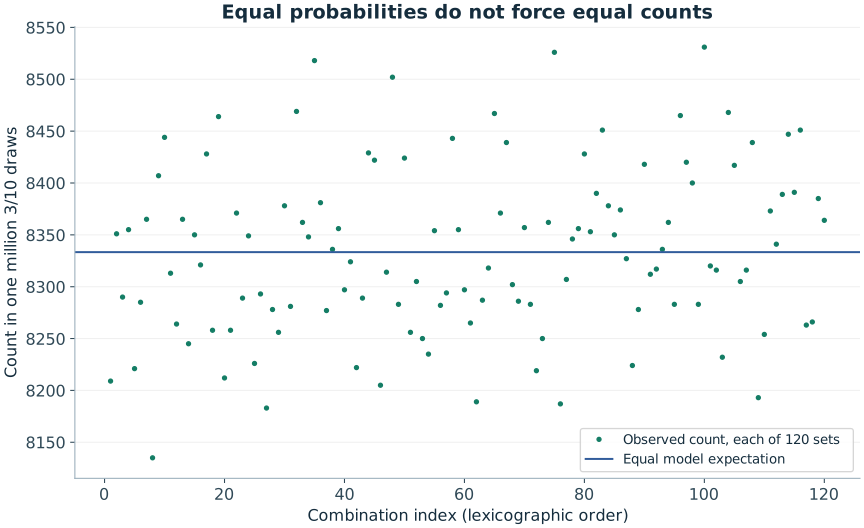
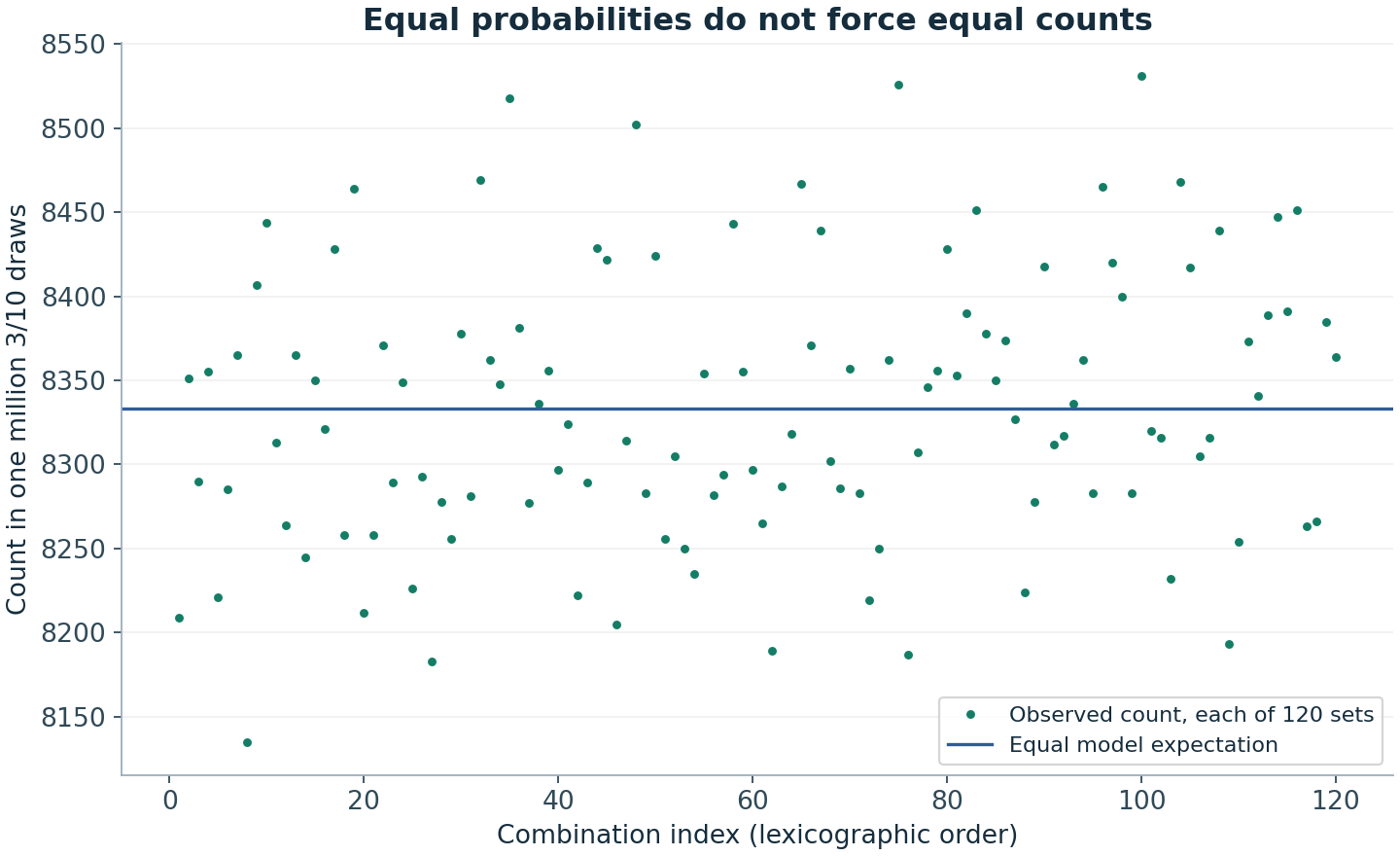
What research contributes Wang and colleagues' study, “Number preferences in lotteries”, documents nonuniform human selection in the datasets it examines. It is evidence about choice behaviour in those settings, not a universal table of today's least popular combinations in every game. We use it to explain why player choices and drawing probabilities are separate distributions.
What automatic selection can legitimately offer It can reduce the effort of choosing, avoid accidental duplicate main labels and provide access to the full permitted range. A correct unrestricted generator samples valid combinations according to its stated model. It should not imply that random-looking lines are better or that re-generating until a line feels right improves its odds.
Official operator selection and an independent website generator are also different services. A line displayed here is not a purchased ticket, registered entry or official Quick Pick transaction.
A useful decision rule If choosing personally is enjoyable and remains within your own boundaries, the mathematics does not require abandoning those numbers. If choosing feels burdensome, an impartial generator can make the choice for you. Neither method makes an independent fair draw more favourable.
The important calculation is attached to the game and the number of distinct full combinations covered. Our game guides link to the relevant generator and show the underlying outcome count. That lets convenience remain convenience, without turning it into an unsupported promise.
Leave the selection to chance
If you want a valid random game line, open the relevant generator. A generated line is not an official entry or a prediction, and it does not improve the probability of a specified valid combination.
Sources and further reading
The worked examples and derivations are RoomForChance explanations. Operator sources establish game parameters; research sources support the specific points identified above. University links are references, not endorsements.
- Wang, Potter van Loon, van den Assem & van Dolder (2016) · Number preferences in lotteriesJudgment and Decision Making 11(3), 243–259. Empirical work on selection behaviour; not evidence that chosen numbers influence a fair draw.
- Joe Blitzstein and Jessica Hwang · Harvard Stat 110 / Introduction to ProbabilityUniversity-level further reading on counting, conditioning and probability models.
Continue the argument
Are Birthday Numbers a Bad Idea? Winning and Sharing Are Different
Why birthday selections have equal draw odds but may concentrate player choices, and why that does not establish a guaranteed financial advantage.
Why Humans Do Not Choose Numbers Randomly
Explore the difference between human selection and uniform sampling, with research on number preferences and a measurable coin-sequence example.
Do More Lottery Tickets Increase Your Odds? The Exact Mathematics
Compare distinct lines in one draw, duplicate lines and repeated independent draws without confusing relative improvement with a likely win.