
Yes. In a uniform lottery selecting six distinct labels from 1–49, the set {1,2,3,4,5,6} has exactly the same probability as any other specified six-number set: 1/13,983,816. Its memorable appearance does not remove it from the outcome space or reduce the probability assigned to it.
The difficulty is not the calculation. It is keeping a single outcome separate from the many-outcome category that intuition silently substitutes for it.
Compare one set with one set Choose another line in advance, perhaps {8,17,23,31,42,49}. It also represents exactly one of C(49,6) sets. If the draw is uniform, the two sets are equiprobable. There are no extra ways for the irregular-looking set to win once its labels have been fixed.
Each set can emerge in 6! extraction orders. Both receive the same multiplicity. Displaying the labels sorted makes one set look especially organized, but does not change the physical or mathematical count.
The category really is rare A set of six consecutive labels can begin at 1, 2, …, 44. There are 44 such sets, so the probability of **some** six-consecutive set is 44/C(49,6). The complement contains 13,983,772 sets and is overwhelmingly more likely as a category.
But you cannot submit “any non-consecutive set” as one ordinary line. Once you choose a particular member of that enormous category, you have returned to one outcome. The category's collective probability does not transfer to each member.
Why a million-draw demonstration can disappoint A specified 6/49 set has expected count only about 0.0715 in one million draws. Most million-draw simulations will contain no occurrence of either of two preselected sets. Two zeros do not provide a useful empirical comparison of their probabilities.
Our Lab therefore uses a clearly labelled 3/10 model. It enumerates all 120 sets and then generates one million draws. The sets 1-2-3 and 2-6-9 produced 8,209 and 8,294 observations in the published run, against the same expectation of 8,333.33. The difference is finite-sample variation; the exact equality comes from the model's symmetry and counting.
Could the orderly line be more popular? Possibly, depending on player behaviour. If a shared prize attracts multiple winning entries, popularity can influence the amount received conditional on winning. That is a different question from draw probability. It requires evidence about selections and the prize rules, not merely a visual judgement about the line.
The useful lesson Chance does not reward a combination for looking as though a human could not have invented it. A random process can produce simple outcomes, and a human can specify complicated-looking ones.
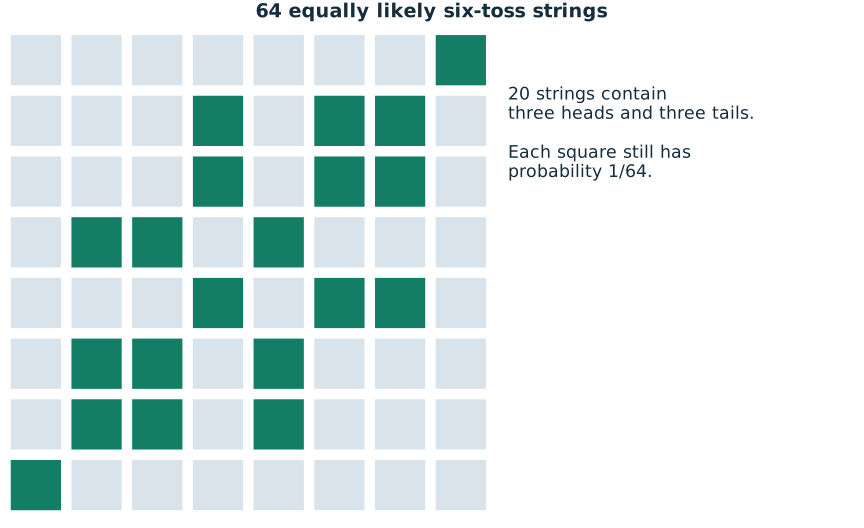
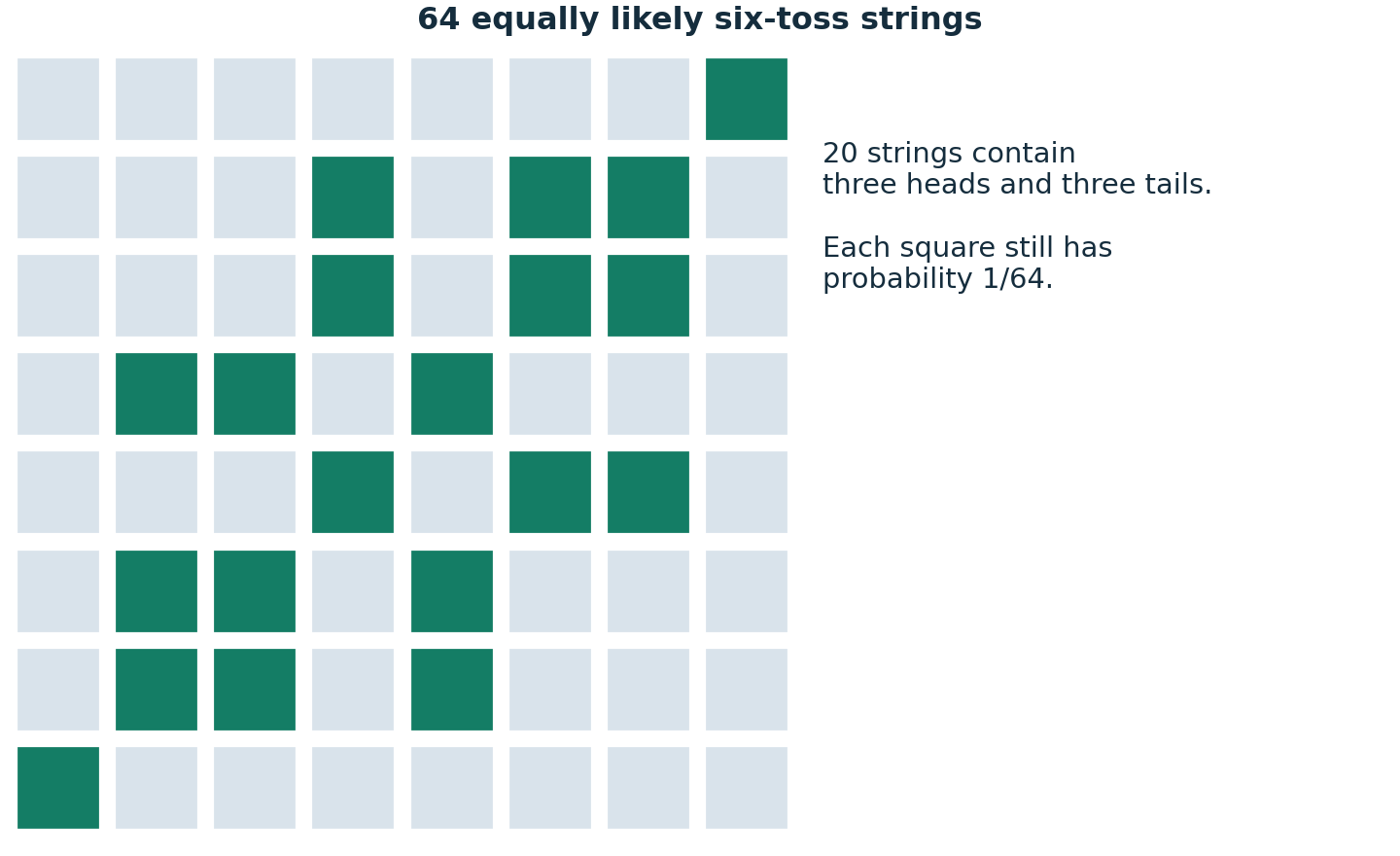
Use the category sketch to see how a broad class contains many equally likely individual outcomes. Then compare the exact calculations for consecutive pairs and odd/even groups. The same logical distinction explains all three questions: a likely category can contain individually rare members, each with no advantage over another specified valid line.
Leave the selection to chance
If you want a valid random game line, open the relevant generator. A generated line is not an official entry or a prediction, and it does not improve the probability of a specified valid combination.
Sources and further reading
The worked examples and derivations are RoomForChance explanations. Operator sources establish game parameters; research sources support the specific points identified above. University links are references, not endorsements.
- Joe Blitzstein and Jessica Hwang · Harvard Stat 110 / Introduction to ProbabilityUniversity-level further reading on counting, conditioning and probability models.
Continue the argument
How Likely Are Consecutive Lottery Numbers? An Exact Formula
Derive the probability of at least one consecutive pair in a k-of-n draw and see why it is nearly half for a 6/49 lottery.
Are Balanced Lottery Numbers Better? Odd and Even Categories Explained
Compute odd/even category probabilities while showing why a three-odd three-even line has no individual advantage over an all-odd line.
What Does a Random Sequence Look Like? The Appearance Trap
Why alternating coins can look more random than genuine samples, and why sorting lottery results changes the patterns you see.