
In a uniform 6/49 draw, the probability of at least one consecutive pair is about 49.52%. Consecutive labels are therefore ordinary, not a vanishingly rare defect in a line. The exact answer is 1−C(44,6)/C(49,6).
The most elegant derivation counts the draws with no consecutive labels and subtracts their probability from one.
Compress the required gaps Write the selected labels in increasing order as x₁ < x₂ < … < xₖ. To avoid consecutive labels, require xᵢ₊₁ ≥ xᵢ + 2. Define yᵢ = xᵢ − (i−1). Removing one required gap before each later label converts the condition into ordinary strict ordering.
The transformed labels form a k-subset of 1 through n−k+1. Conversely, adding the gaps back reconstructs exactly one original no-adjacency set. This one-to-one correspondence gives C(n−k+1,k) sets with no consecutive pair.
Divide by C(n,k), then take the complement. If there is not enough room for k nonadjacent labels, the no-adjacency count is zero and at least one pair is certain.
Apply the formula to 6/49 Here n−k+1 = 44. There are C(44,6) = 7,059,052 sets without a consecutive pair, out of 13,983,816 total. Their complement has probability approximately 0.4951984494.
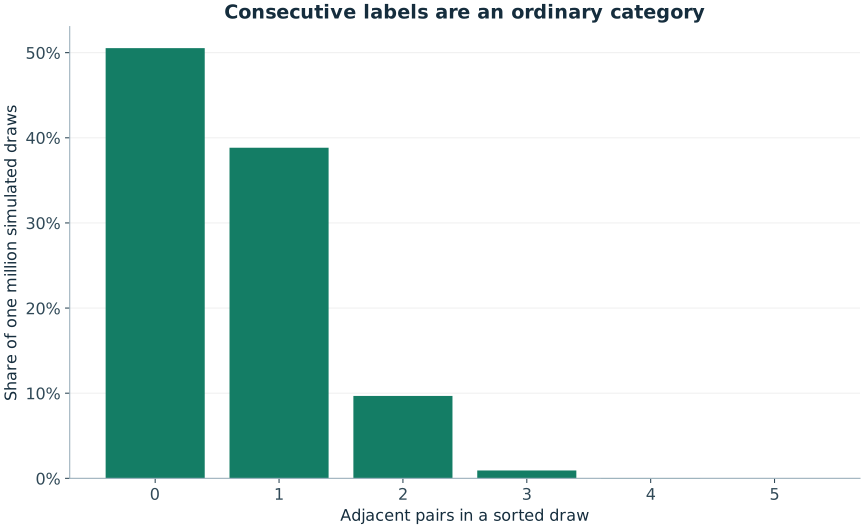
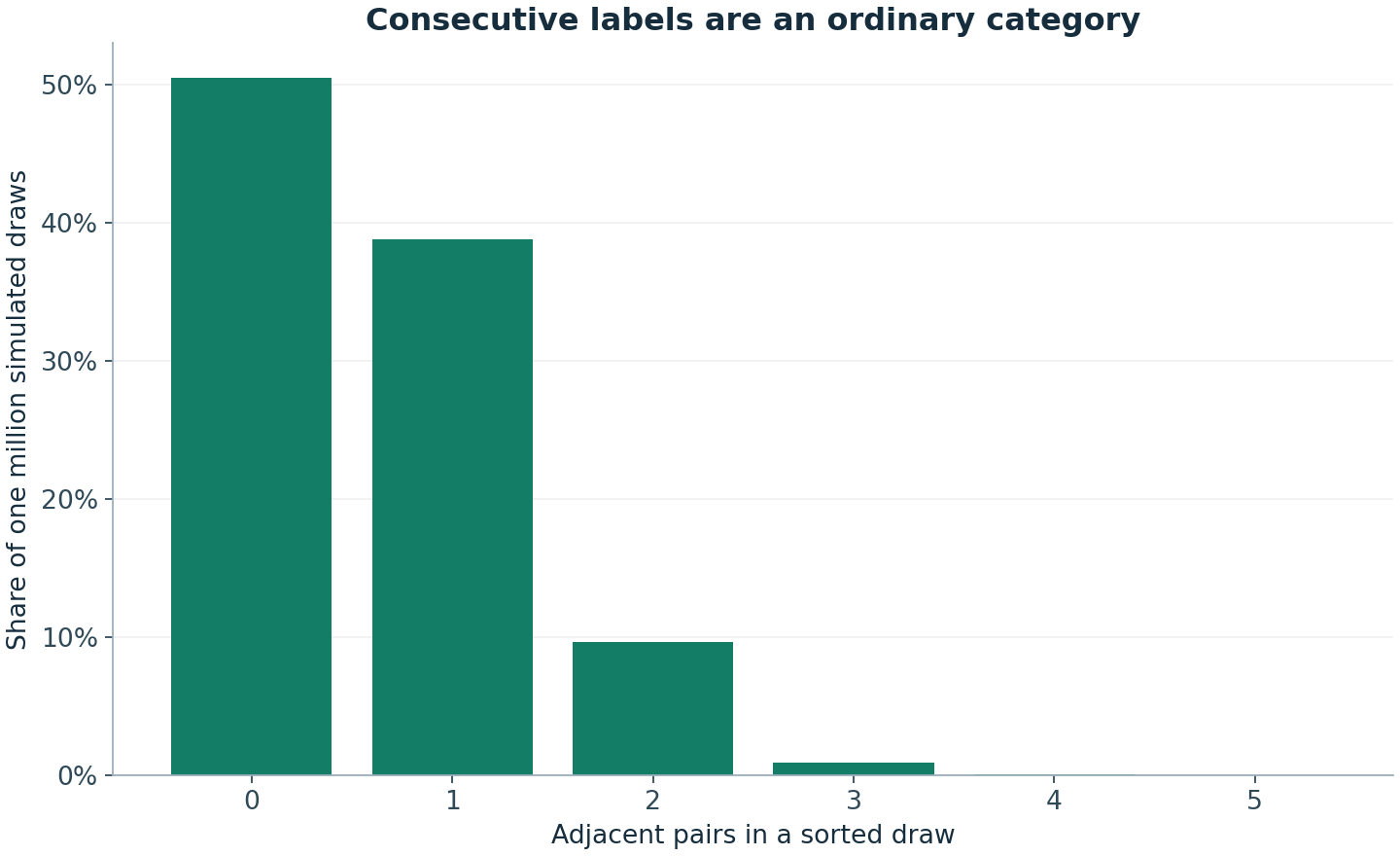
Our million-draw experiment observed a pair in 49.4678% of draws. The theoretical value is 49.5198%. Simulation frequencies fluctuate; the exact combinatorial answer does not depend on the seed.
One specified pair is a different event The chance that both 17 and 18 appear is C(47,4)/C(49,6) = 6×5/(49×48). That is much smaller than the probability of **any** consecutive pair because there are 48 possible adjacent label pairs and their events overlap.
Adding the 48 individual pair probabilities gives the expected number of adjacent pairs, not the probability of at least one. A draw containing 17,18,19 contributes two adjacent pairs and is counted twice in that sum.
Runs, pairs and complete sequences A three-label run contains two adjacent pairs. A six-label consecutive set contains five. Counting maximal runs is another statistic. A rigorous table states whether it counts pairs, runs, or the event that at least one pair exists.
Our experiment reports the number of adjacent differences equal to one in the sorted set. That definition is directly reproducible and avoids ambiguous phrases such as “two consecutive numbers twice”.
Does avoiding adjacency help? It removes nearly half the possible 6/49 outcomes from your selection procedure. The line you eventually select remains one valid set with probability 1/C(49,6). Excluding a common category does not make the surviving specified line more likely.
Use the calculator to change n and k and watch the category probability change. The calculation is useful for understanding what random draws look like, not for filtering a fair game into a more favourable one.
Leave the selection to chance
If you want a valid random game line, open the relevant generator. A generated line is not an official entry or a prediction, and it does not improve the probability of a specified valid combination.
Sources and further reading
The worked examples and derivations are RoomForChance explanations. Operator sources establish game parameters; research sources support the specific points identified above. University links are references, not endorsements.
- Joe Blitzstein and Jessica Hwang · Harvard Stat 110 / Introduction to ProbabilityUniversity-level further reading on counting, conditioning and probability models.
Continue the argument
Is 1-2-3-4-5-6 as Likely as Any Other Lottery Combination?
Yes under a uniform 6/49 model. Understand why a specific ordered-looking line differs from the broad category of all consecutive sets.
Three Consecutive Lottery Numbers: Why Pair Counting Is Not Enough
Calculate a specified triple, distinguish expected triple counts from occurrence probability, and avoid double-counting overlapping runs.
Are Balanced Lottery Numbers Better? Odd and Even Categories Explained
Compute odd/even category probabilities while showing why a three-odd three-even line has no individual advantage over an all-odd line.