
Three consecutive labels in a lottery draw are less common than a single adjacent pair, but their probability cannot be found by squaring the probability of a pair. The events overlap, and sampling without replacement creates dependence. Begin by deciding whether you mean one specified triple or any triple anywhere in the draw.
A specified triple is straightforward In a uniform k-of-n draw, the probability that a particular set of three labels is included is C(n−3,k−3)/C(n,k), provided k is at least three. This simplifies to k(k−1)(k−2)/[n(n−1)(n−2)].
For a 6/49 draw, the probability that 17,18,19 are all included is 120/(49×48×47), approximately 0.1086%. The other three labels can be any valid labels outside the specified triple. The calculation does not require the entire six-label set to be consecutive.
Any triple introduces overlap There are n−2 possible consecutive triples: 1-2-3 through (n−2)-(n−1)-n. Summing their individual inclusion probabilities gives the expected number of included triples. In 6/49, that expectation is (47×120)/(49×48×47) = 120/(49×48), approximately 0.05102 triples per draw.
It is not the probability of at least one triple. A four-label run contains two triples, so it contributes twice. The expectation is an upper bound on the probability of at least one, but it counts multiplicity rather than just occurrence.
A small example exposes the difference The set {1,2,3,4,20,30} contains the triples 1-2-3 and 2-3-4. It contains three adjacent pairs. It contains one maximal consecutive run of length four. Those are three legitimate summaries of the same set, with different numerical values.
An article that uses the words pair, triple and run interchangeably can make an apparently sophisticated calculation fundamentally unclear.
An exact method for any triple Scan labels 1 through n, keeping track of how many have been selected and the current consecutive run length. At each label, either omit it, which resets the run length to zero, or include it, which increases the run length. To count sets with no triple, forbid transitions to run length three.
A dynamic program over these states counts all k-subsets without a run of three. Subtract that count from C(n,k) to obtain the number with at least one triple. This method handles overlap automatically and can be generalized to longer runs.
What simulation should measure A simulation can sort each draw and check whether two adjacent differences in succession are both one. That detects at least one triple without counting a four-run twice. If the goal is instead the number of triples, count every eligible starting position and label the result accordingly.
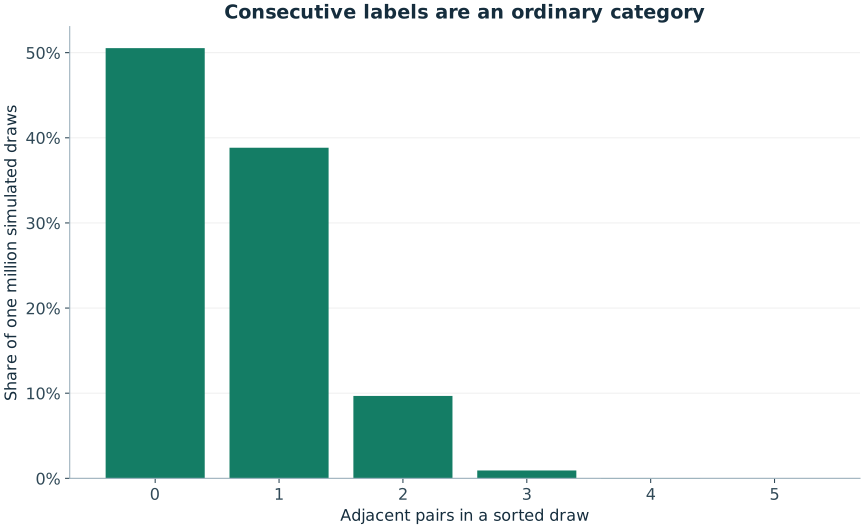
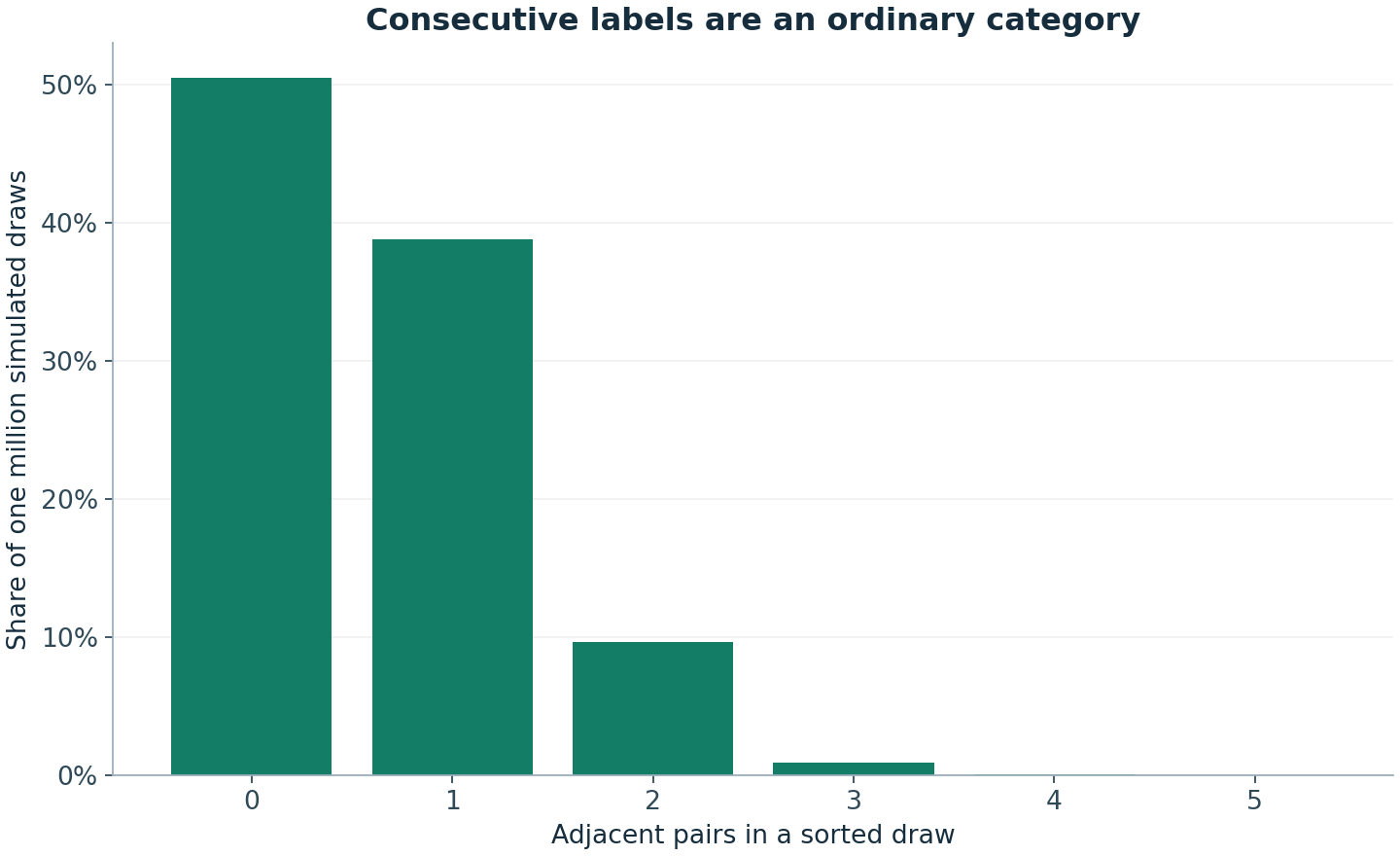
Our consecutive-pair experiment deliberately studies pairs, not triples. Its chart should not be reused as evidence about triples without changing the measurement. Precision about the event is the foundation of an honest probability calculation; the rarity or visual impact of a result comes afterwards.
Leave the selection to chance
If you want a valid random game line, open the relevant generator. A generated line is not an official entry or a prediction, and it does not improve the probability of a specified valid combination.
Sources and further reading
The worked examples and derivations are RoomForChance explanations. Operator sources establish game parameters; research sources support the specific points identified above. University links are references, not endorsements.
- Joe Blitzstein and Jessica Hwang · Harvard Stat 110 / Introduction to ProbabilityUniversity-level further reading on counting, conditioning and probability models.
Continue the argument
How Likely Are Consecutive Lottery Numbers? An Exact Formula
Derive the probability of at least one consecutive pair in a k-of-n draw and see why it is nearly half for a 6/49 lottery.
How to Calculate the Probability of Matching Lottery Numbers
Derive the hypergeometric formula for exactly r matches and distinguish exact, at-least and separate-pool matching events.
Monte Carlo Simulation: Learn Probability by Repeating the Model
Build a trustworthy probability simulation with a defined event, reproducible generator, uncertainty estimate and exact benchmark where available.