
AI can generate lottery numbers, calculate probabilities and summarize historical results. Those capabilities do not imply that it can predict a fair independent draw. A learning algorithm needs information that is related to the future target. If the past carries no such information, a more elaborate model cannot manufacture it.
The key distinction is between learning patterns in a dataset and learning a relationship that persists outside that dataset.
The mathematical obstacle Let H denote all historical draw information available to a model, and let S(H) be the complete valid combination it chooses. If the next draw D is uniform over M outcomes and independent of H, then P(D = S(H) | H) = 1/M.
Averaging over all possible histories still gives 1/M. The selected combination can depend on millions of model parameters; conditional on the past, it remains one specified combination facing a fresh uniform draw.
Why a convincing backtest can appear A flexible model can fit noise. Researchers or promoters can also try many windows, features, architectures and scoring rules, then display the best historical result. If the same test set guides those choices, it has become part of the training process, even when it retains the name “test”.
Data leakage is another danger. Features may accidentally contain information from the target draw, or random train/test splits may fail to respect the intended forecasting timeline. A polished graph cannot repair those design errors.
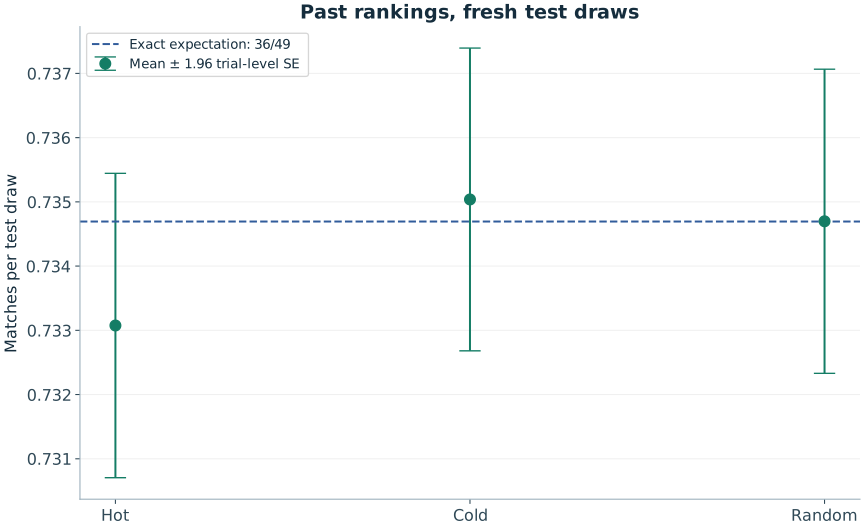
What would count as evidence? Specify the prediction rule, eligible games, evaluation period and scoring metric before observing the test results. Preserve timestamped predictions. Compare with a suitable random baseline. Account for the number of models and hypotheses tried. Evaluate on genuinely untouched future data, with enough observations for the claimed effect.
A claim about jackpot prediction faces a severe sample-size problem because jackpots are rare. A claim about partial matches is easier to study, but it must not be promoted as proof of profitable jackpot prediction. The outcome being measured must match the conclusion.
What if the real mechanism is biased? A persistent physical or software defect would violate the fair-independent model and could, in principle, create a signal. Establishing that defect requires strong evidence and independent validation. Its mere logical possibility is not evidence that a commercial prediction system has found it.
An appropriate investigation would separate rule changes, machine changes, data errors and ordinary variation. It would not infer a stable advantage solely from a leaderboard of historical frequencies.
Useful roles for AI that do not require prediction AI can help explain a formula, organize source material, inspect code and propose testable hypotheses. Each output still needs verification. In this Lab, numerical results come from executed published programs, and exact probabilities come from explicit counting arguments.
A generator can leave the choice to chance without claiming to outsmart chance. That is a more precise description of the service than attaching an “AI score” to a line whose full-match probability remains unchanged. Ask a prediction claim for its prospective evidence, not merely its vocabulary.
Leave the selection to chance
If you want a valid random game line, open the relevant generator. A generated line is not an official entry or a prediction, and it does not improve the probability of a specified valid combination.
Sources and further reading
The worked examples and derivations are RoomForChance explanations. Operator sources establish game parameters; research sources support the specific points identified above. University links are references, not endorsements.
- Joe Blitzstein and Jessica Hwang · Harvard Stat 110 / Introduction to ProbabilityUniversity-level further reading on counting, conditioning and probability models.
Continue the argument
Why Lottery Backtesting Can Fool You
Spot overfitting, test-set reuse and future leakage, and learn what a fair prospective evaluation of a lottery selection rule would require.
Do Hot and Cold Lottery Numbers Work? A Holdout Test
Examine hot and cold selection rules using conditional probability and an original experiment with separate training and test draws.
Can Statistical Tests Prove Lottery Numbers Are Random?
Learn what frequency, runs and goodness-of-fit tests can detect, and why passing tests is not proof of fairness or unpredictability.