
Lottery probability begins with a counting question: what are the possible outcomes, and which of them satisfy the event you care about? If all outcomes in the model are equally likely, the probability is the number of favourable outcomes divided by the total. Most mistakes begin before the division, when the wrong outcomes are counted.
Define the event precisely “Winning” might mean matching every main number, matching a smaller prize tier, receiving a free entry, or sharing a jackpot. These are not interchangeable. A calculation of jackpot probability cannot be presented as the probability of any prize, and neither tells you the probability of making a net profit after a series of purchases.
Start with a simple model: six different numbers are selected uniformly from 1–49, and their order does not matter. A specified six-number line wins the main match if it equals the drawn set.
Count unordered sets There are 49 choices for the first ball, 48 for the second, and so on through 44 for the sixth. Multiplying gives the count of ordered extractions. But each unordered set occurs in 6! = 720 possible orders. Divide by 720 to obtain C(49,6) = 13,983,816 sets.
A specified line corresponds to one set, so its probability is 1/13,983,816. This calculation does not depend on whether the labels form a sequence, contain birthdays or look irregular.
Additional pools multiply possibilities If a game also selects one special ball from a separate pool of b labels, every main set can be paired with b special outcomes. The full-match outcome count is C(n,k)b. If it selects s distinct special labels from a separate pool of b, the count is C(n,k)C(b,s).
That multiplication is appropriate for separately drawn pools under the stated model. A bonus ball drawn from the remaining main pool is structurally different. It must be modelled according to its actual role in the prize tier, rather than appended as an independent multiplier.
Partial matches require another count For a fixed k-number ticket against a uniform k-of-n main draw, exactly r matches occur in C(k,r)C(n−k,k−r) sets. Choose r labels from the ticket and the remaining drawn labels from outside it, then divide by C(n,k).
This counts exactly r. “At least r” requires adding the probabilities for r, r+1 and so on. Forgetting that distinction can substantially change an answer.
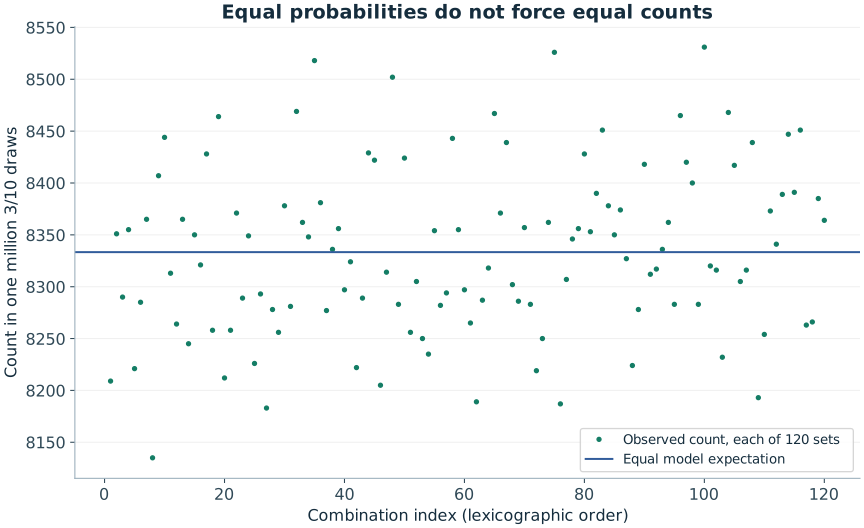
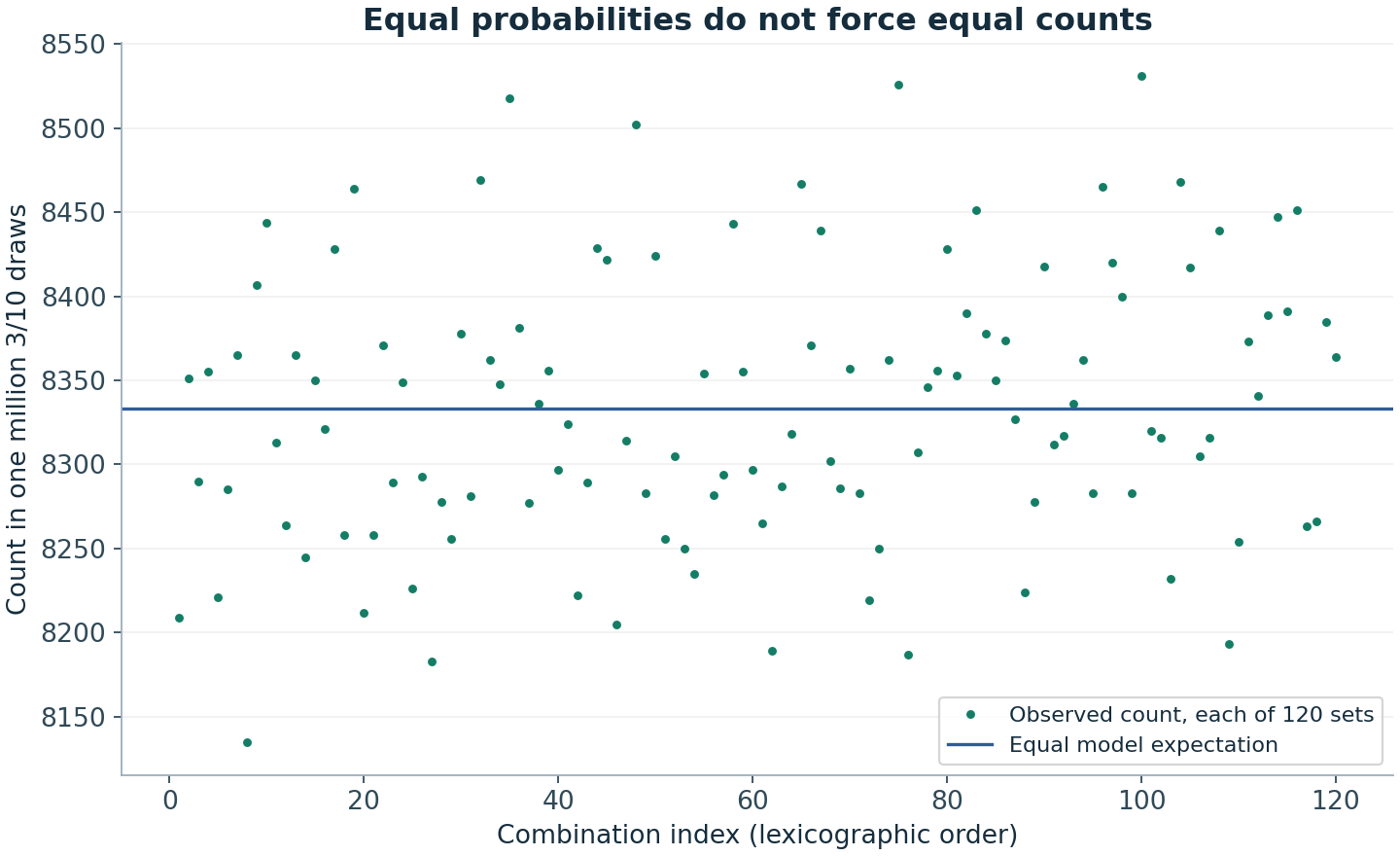
What simulation contributes Simulation helps readers see frequencies fluctuate around theoretical expectations and explore models whose formulas are awkward. It is an inefficient way to establish a very small probability that can be counted exactly. A million trials is large for a classroom demonstration but small for a one-in-hundreds-of-millions event.
The calculators use exact combination counts where possible, while the Lab labels observed frequencies as simulation results. Keep those roles separate. Mathematics describes the model; official rules establish which model fits a particular game; neither supplies a system for predicting the next independent result.
Leave the selection to chance
If you want a valid random game line, open the relevant generator. A generated line is not an official entry or a prediction, and it does not improve the probability of a specified valid combination.
Sources and further reading
The worked examples and derivations are RoomForChance explanations. Operator sources establish game parameters; research sources support the specific points identified above. University links are references, not endorsements.
- Joe Blitzstein and Jessica Hwang · Harvard Stat 110 / Introduction to ProbabilityUniversity-level further reading on counting, conditioning and probability models.
Continue the argument
How Many Lottery Combinations Are There? The C(n,k) Formula
Derive the lottery combination formula, work through C(49,6), and learn when separate pools or ordered digits require a different count.
How Bonus Balls and Separate Number Pools Change Lottery Odds
Separate special-ball pools and bonus balls drawn from the main pool need different formulas. Learn the distinction with worked examples.
How to Calculate the Probability of Matching Lottery Numbers
Derive the hypergeometric formula for exactly r matches and distinguish exact, at-least and separate-pool matching events.