
“Pseudorandom” does not mean useless or visibly fake. It means that an algorithm generates values deterministically from an internal state. If the same implementation starts with the same state and receives the same operations, it produces the same stream. Whether that is an advantage or a problem depends on the task.
Two experiments with different requirements A teacher simulating coin tosses may want every student to obtain the same table. A published scientific experiment should allow another researcher to reproduce its calculations. In those settings, a recorded seed and software version are valuable.
A system creating a secret security token needs something else: an outsider must not be able to reproduce the token. Reusing a public demonstration seed would defeat that requirement, no matter how convincing the output histogram looked.
Physical entropy is a source, not a complete application A physical random source observes a process with uncertainty, such as electronic noise. Raw measurements may have bias, correlation or environmental dependencies, so a practical system must handle them appropriately. Merely attaching the label “physical” does not establish that every final output is uniform or that an implementation is safe.
Conversely, a cryptographic pseudorandom generator can be seeded from physical entropy and then provide output efficiently. Real systems often combine these ideas rather than choosing a simple “true or pseudo” box.
A finite demonstration Consider the recurrence x_next = (5x + 1) mod 16. Starting at zero produces 1, 6, 15, 12, and so on. The sequence can look varied, but the rule and state determine every next value. Revealing the state reveals the future. This tiny construction is an illustration, not a suitable generator recommendation.
A modern simulation generator is much more sophisticated, but determinism still gives it its reproducibility. A cryptographic generator is additionally designed to resist practical inference of its hidden state from observed outputs.
What statistical tests can and cannot establish A test may detect an imbalance of zeros and ones, unexpected runs, or other deviations from a reference model. Passing a collection of tests means those tests did not detect their targeted deviations in that sample. It does not prove that an algorithm cannot be predicted by someone who knows its structure.
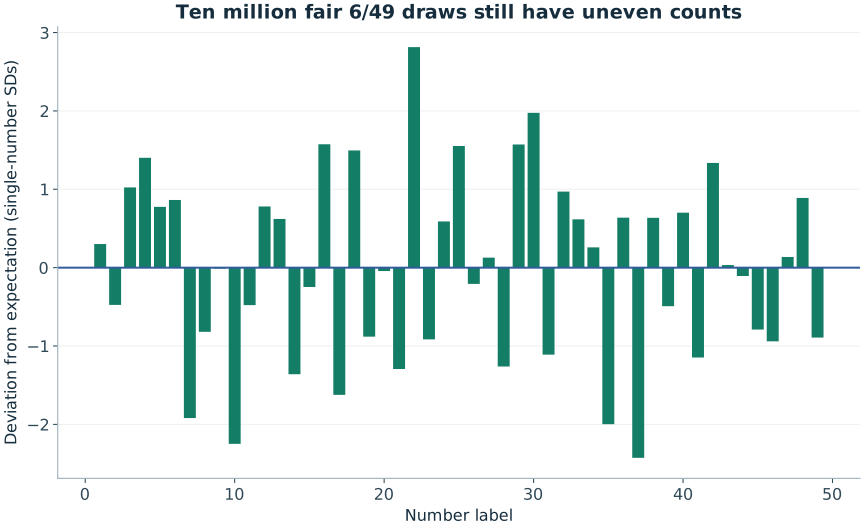
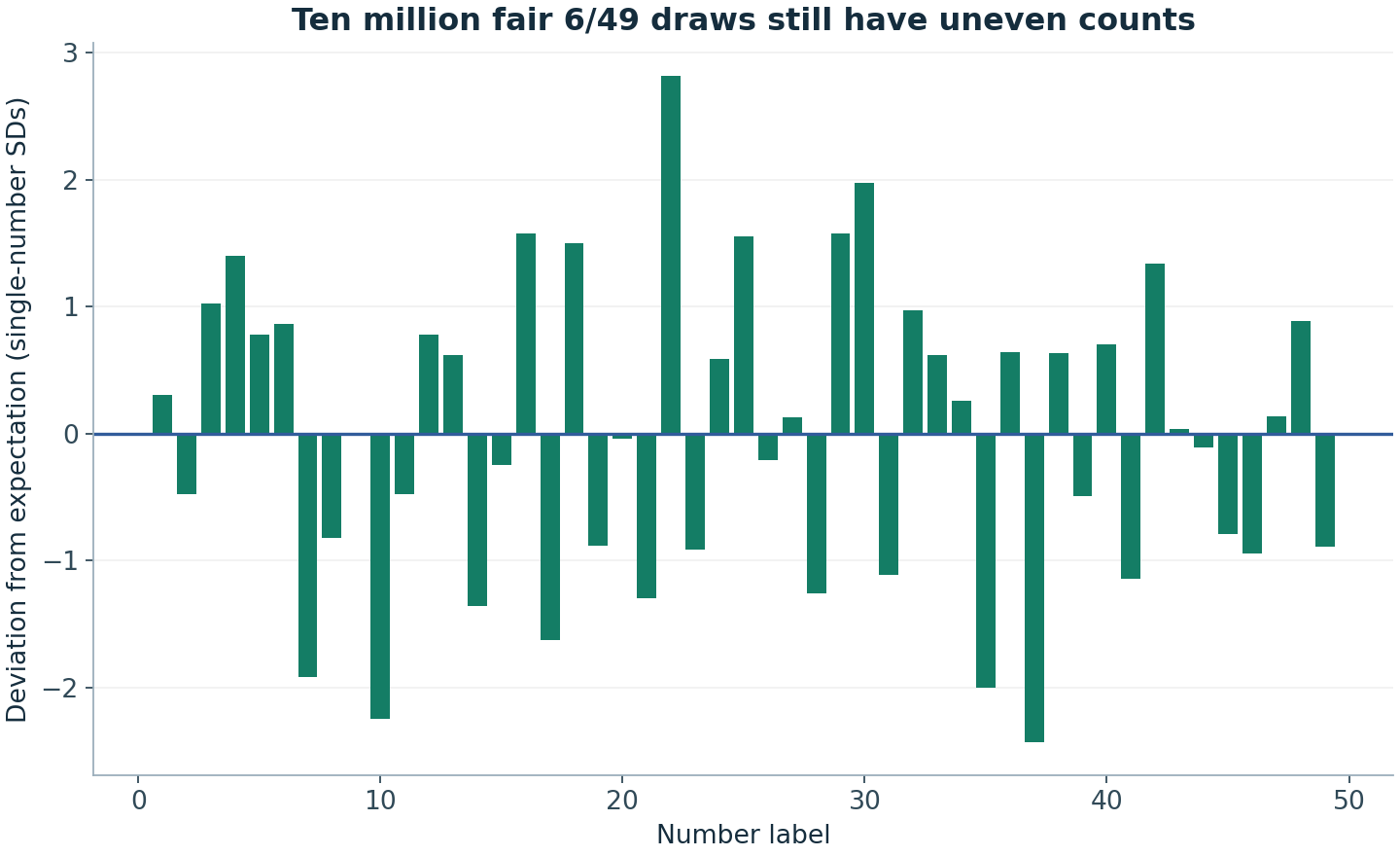
A deterministic file of carefully selected digits can pass a frequency test while being entirely public. An unpredictable source can produce a lopsided short sample. Neither observation contradicts the distinction between appearance and security.
Which approach fits RoomForChance experiments? The Lab uses NumPy PCG64 with recorded seeds, a recorded environment and published code. We call those outputs **pseudorandom simulations**, not measurements of physical randomness. Their purpose is to illustrate specified probability models and permit independent reproduction.
For an impartial everyday number choice, the full implementation must still map its source correctly into the allowed outcomes. For a security-sensitive task, use the platform's appropriate cryptographic facility and established protocols. In neither case does the kind of generator improve the winning probability of a specified valid line in a separate uniform lottery draw.
Leave the selection to chance
If you want a valid random game line, open the relevant generator. A generated line is not an official entry or a prediction, and it does not improve the probability of a specified valid combination.
Sources and further reading
The worked examples and derivations are RoomForChance explanations. Operator sources establish game parameters; research sources support the specific points identified above. University links are references, not endorsements.
- NumPy · PCG64 documentationGenerator reference. Exact Lab reproduction uses the recorded NumPy version, rather than assuming the current documentation version matches it.
- Joe Blitzstein and Jessica Hwang · Harvard Stat 110 / Introduction to ProbabilityUniversity-level further reading on counting, conditioning and probability models.
Continue the argument
What Is a Random Seed? Reproducing an Experiment Correctly
A random seed is only part of a reproducible simulation. Learn why the algorithm, versions and sequence of calls must also be recorded.
Cryptographically Secure Random Numbers: What the Claim Means
Learn why CSPRNGs concern unpredictability, why Math.random is different, and why a secure source still needs unbiased range conversion.
Can Statistical Tests Prove Lottery Numbers Are Random?
Learn what frequency, runs and goodness-of-fit tests can detect, and why passing tests is not proof of fairness or unpredictability.