
A random seed initializes a pseudorandom generator. It is the starting instruction for a deterministic stream, not a lucky number that improves the stream's outcomes. The same seed can help reproduce an experiment, but only when the rest of the experiment is specified closely enough.
Why a seed alone is incomplete Two different generator algorithms can accept the seed 42 and produce different streams. Two libraries can transform the same underlying random bits into distributions differently. Even the same program can produce a different result if it changes the order in which it consumes random values.
Suppose a simulation first creates a random colour and then a die roll. Remove the colour call, and the die may now use the bits that previously selected the colour. The generator has not malfunctioned; the program has changed which part of the stream belongs to which operation.
A reproducibility record needs several pieces Record the generator family, seed, software versions, parameters, sampling procedure, and source code. State whether trials share a stream or start separate streams. If a simulation is split into batches, preserve the batch procedure when exact replay matters. A source-file checksum can help readers identify which version produced a result.
RoomForChance Lab gives each experiment its own seed derived from a published base value and experiment number. Running an earlier experiment is therefore not required to advance the generator to the state used by a later one. Within each experiment, the published code determines the exact call sequence.
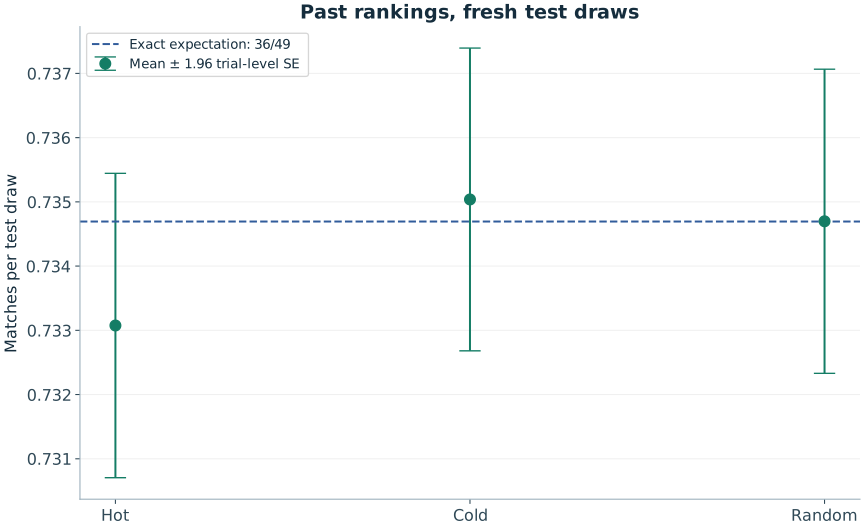
Repeating a seed is not a replication study Running the identical program with the identical seed is a reproduction check: it verifies that another environment can obtain the same result. Repeating the experiment with new independent streams examines Monte Carlo variability. Both are useful, but they answer different questions.
If a claimed pattern disappears with a new seed, it may have been ordinary sampling noise. If it persists, further checks are still needed: perhaps the pattern is a correct property of the model, or perhaps both runs share the same implementation error.
Can you search for a good seed? You can search for a seed whose output looks attractive. But doing so selects results after inspection. A chart built from the most dramatic of thousands of tried seeds is no longer an ordinary unselected illustration. If seed selection is part of an experiment, that selection procedure must be disclosed and included in the analysis.
For lottery number choice, a seed that once produced a winning historical line has no special relationship with a future independent draw. It describes the generator's past output, not the lottery machine's future behaviour.
The security boundary Published seeds are useful for transparent demonstrations and unsuitable as the sole secret behind security-sensitive randomness. Reproducibility and secrecy pull in different directions. Do not copy a public Lab seed into a password, token or cryptographic key generator.
When downloading an experiment, start by reproducing the published result, then vary the seed or parameters deliberately. Keep the changed run labelled as a new run. That simple discipline prevents a reproducibility check from quietly turning into an undocumented search for an exciting outcome.
Leave the selection to chance
If you want a valid random game line, open the relevant generator. A generated line is not an official entry or a prediction, and it does not improve the probability of a specified valid combination.
Sources and further reading
The worked examples and derivations are RoomForChance explanations. Operator sources establish game parameters; research sources support the specific points identified above. University links are references, not endorsements.
- NumPy · PCG64 documentationGenerator reference. Exact Lab reproduction uses the recorded NumPy version, rather than assuming the current documentation version matches it.
- Joe Blitzstein and Jessica Hwang · Harvard Stat 110 / Introduction to ProbabilityUniversity-level further reading on counting, conditioning and probability models.
Continue the argument
True Random vs Pseudorandom: Which Difference Matters?
Compare physical entropy and deterministic random streams without confusing reproducibility, statistical quality and cryptographic security.
Monte Carlo Simulation: Learn Probability by Repeating the Model
Build a trustworthy probability simulation with a defined event, reproducible generator, uncertainty estimate and exact benchmark where available.
Monte Carlo Error: Why a Million Trials Can Still Be Too Few
Estimate simulation precision, understand zero observed successes and distinguish absolute error from relative error for rare events.