
A basketball player's recent performance and a lottery ball's recent appearances are not the same kind of evidence. Human skill, fatigue, confidence, opponents and conditions can change. A fair independent lottery model explicitly removes predictive dependence between complete draws. Calling both situations “hot” does not make their mechanisms equivalent.
This distinction is especially important because the scientific literature on the hot hand is more nuanced than the slogan “streaks are always imaginary”.
A correction within the research literature Miller and Sanjurjo's paper, “Surprised by the Hot Hand Fallacy? A Truth in the Law of Small Numbers”, identifies a bias in a commonly used measure of performance following streaks in finite sequences. Their analysis challenged conclusions drawn from a canonical hot-hand study.
That result is a lesson about statistical design and the interpretation of human performance data. It does not show that a fair lottery label becomes more likely after recent appearances. Transferring the conclusion without transferring the mechanism would be an error.
What the lottery null model says For a specified label with inclusion probability p, independent draws give P(next inclusion | any specified past history) = p. A streak of recent inclusions can be rare, but it does not change this conditional probability.
A hot-hand alternative would require positive dependence or a changing probability. That is a different model. To support it, evidence must distinguish it from ordinary variation, selection effects and data-quality problems.
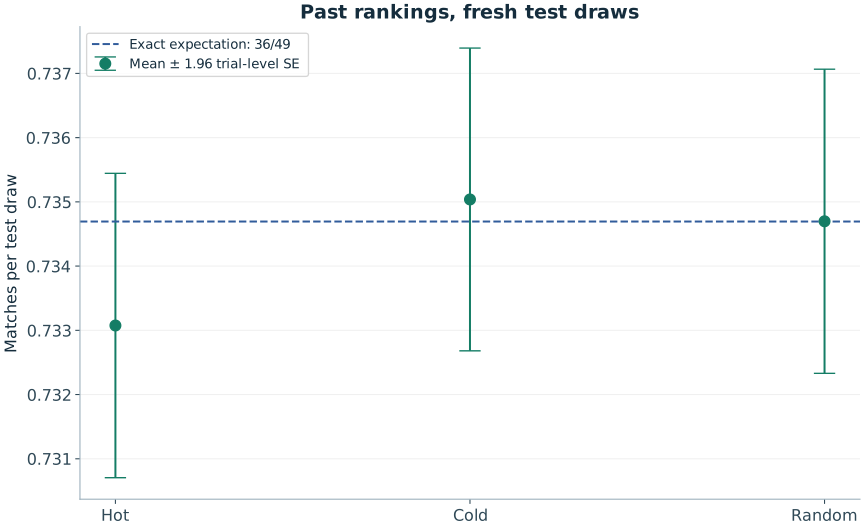
Selecting observations can distort a comparison Suppose an analysis keeps only occasions that follow a certain streak and then compares their average with a baseline. Which occasions qualify depends on the same finite sequence being analysed. That selection can create subtle effects. The exact design, denominator and estimator matter.
One way to avoid a related trap in a lottery demonstration is to select hot labels using one dataset, freeze them, and evaluate against a genuinely separate dataset. Our Lab does that with independent training and test blocks. It does not search within the test data for the most persuasive window.
Why a streak can still be informative elsewhere In a changing real-world process, observations may update beliefs about an underlying state. Several good performances might be evidence that an athlete is healthy or that conditions favour a technique. Whether they actually are requires domain evidence; independence cannot simply be assumed or rejected on intuition.
Likewise, a machine fault could make a lottery model inappropriate. But a chart of recent winners alone does not establish that fault. The burden is to demonstrate persistent out-of-sample behaviour under a sound analysis.
A more rigorous way to speak Say “past draws do not predict the next draw under the fair independent model”. Avoid saying “all hot-hand effects everywhere are a fallacy”. The narrower statement is both stronger mathematically and more faithful to the research.
Our aim is to distinguish mechanisms before comparing patterns. That lets the reader appreciate genuine scientific revisions without converting them into a lottery prediction claim they do not support.
Leave the selection to chance
If you want a valid random game line, open the relevant generator. A generated line is not an official entry or a prediction, and it does not improve the probability of a specified valid combination.
Sources and further reading
The worked examples and derivations are RoomForChance explanations. Operator sources establish game parameters; research sources support the specific points identified above. University links are references, not endorsements.
- Miller & Sanjurjo · Surprised by the Hot Hand Fallacy?Author manuscript of research published in Econometrica 86(6), 2019–2047 (2018). The arXiv record was posted in 2019.
- Miller & Sanjurjo (2018) · University-hosted manuscriptFull research paper on streak selection bias. Its conclusions must not be transferred uncritically from human performance to independent lottery draws.
- Joe Blitzstein and Jessica Hwang · Harvard Stat 110 / Introduction to ProbabilityUniversity-level further reading on counting, conditioning and probability models.
Continue the argument
Do Hot and Cold Lottery Numbers Work? A Holdout Test
Examine hot and cold selection rules using conditional probability and an original experiment with separate training and test draws.
Why Lottery Backtesting Can Fool You
Spot overfitting, test-set reuse and future leakage, and learn what a fair prospective evaluation of a lottery selection rule would require.
Independent Events: Why a Fair Draw Has No Memory
Learn conditional probability with coins and lottery draws, including why balls within one draw are dependent while separate draws can be independent.