
Randomness is a property of how outcomes arise, not a promise that the outcomes will look untidy. A fair coin may produce six heads. A fair lottery may produce consecutive numbers. Neither observation, by itself, tells us that the process has stopped being random. To reason clearly about chance, begin with the mechanism and the set of possible outcomes, then ask what that mechanism makes likely.
Three questions hidden inside one word People use “random” to mean several different things. **Unpredictability** asks whether someone can anticipate the next result. **Uniformity** asks whether the possible results have equal probabilities. **Independence** asks whether learning an earlier result changes the probability of a later one. These properties are related, but none should be silently substituted for another.
Imagine a concealed machine that cycles through 1, 2, 3, 4. Its long-run frequencies are perfectly uniform, yet its next output is predictable once the cycle is known. Now imagine a genuinely uncertain coin that lands heads 60% of the time. Its results can be independent without being equally likely. Finally, draw two balls from a bag without putting the first back. Both positions can have uniform marginal distributions, even though the second draw depends on the first.
A lottery makes the distinction concrete In a uniform 6/49 model, the outcome is an unordered set of six different numbers. There are C(49,6) = 13,983,816 such sets. Every specified set has probability 1/13,983,816. However, the individual balls drawn during one extraction are not independent: after a ball has been removed, it cannot appear again in that extraction.
Independence normally enters between complete draws, once the full pool has been restored and the drawing process is suitably reset. That is why “lottery numbers are independent” is too loose a sentence. It can be wrong inside a draw and appropriate between draws.
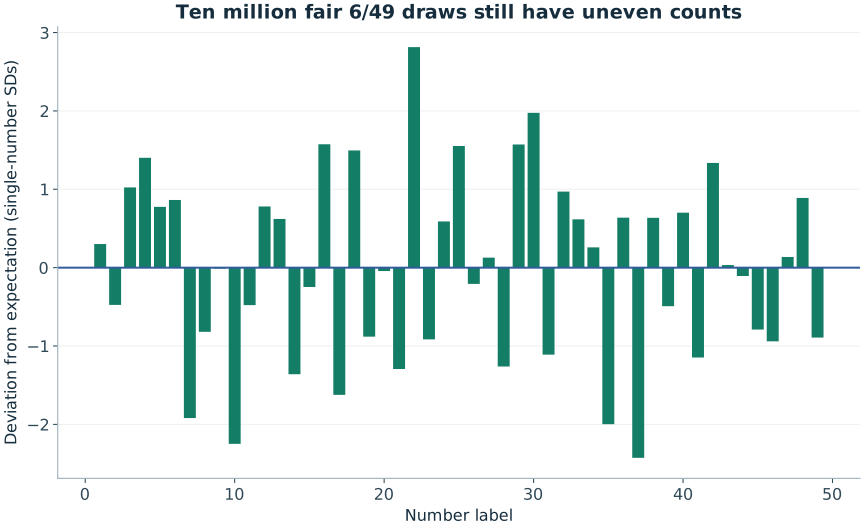
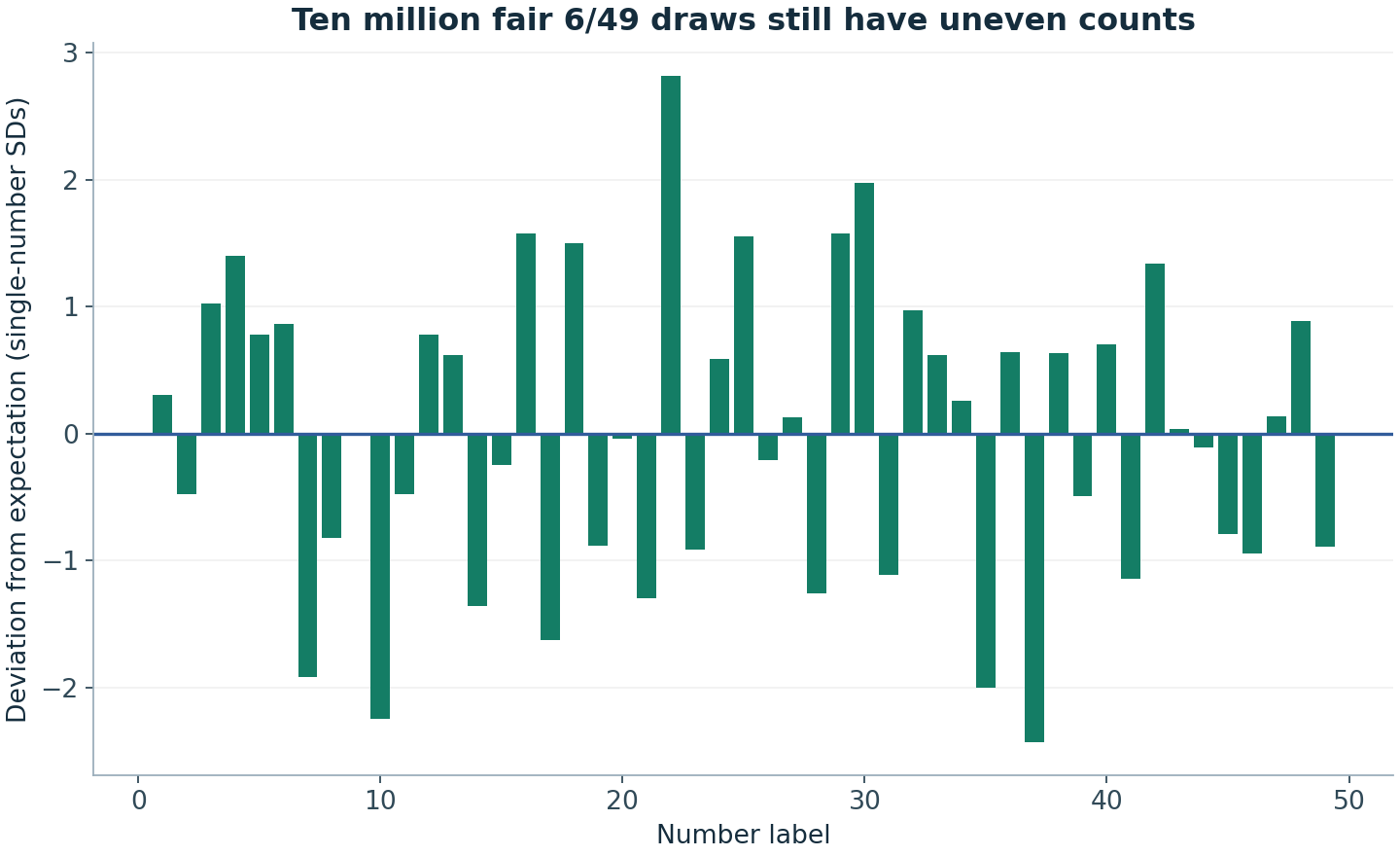
Why patterns survive randomness Suppose you divide all possible sets into two groups: those containing a consecutive pair and those without one. The first group contains many millions of sets. It can therefore be common even though each particular set is rare. A pattern is not automatically evidence against randomness; the relevant question is how much of the outcome space has that pattern.
There is a second trap. A pattern noticed after a result has occurred was not necessarily the pattern you would have predicted beforehand. Given enough possible descriptions—odd numbers, repeated endings, birthdays, sums, gaps—some description will make almost any result sound remarkable.
What randomness does not promise It does not promise that every number appears equally often in a short sample. It does not promise that a losing streak will be compensated. It does not guarantee that a computer implementation is correct. And a statistical test that finds no problem does not establish perfect randomness for every conceivable use.
Our Lab starts with explicit models and publishes reproducible simulations. Those experiments show what particular random mechanisms can produce; they do not certify an operator's equipment or reveal tomorrow's result. Use the accompanying calculators to explore probability, and use a game generator if you simply want to leave a choice to chance. Neither changes the probability assigned to a valid lottery combination.
Leave the selection to chance
If you want a valid random game line, open the relevant generator. A generated line is not an official entry or a prediction, and it does not improve the probability of a specified valid combination.
Sources and further reading
The worked examples and derivations are RoomForChance explanations. Operator sources establish game parameters; research sources support the specific points identified above. University links are references, not endorsements.
- Joe Blitzstein and Jessica Hwang · Harvard Stat 110 / Introduction to ProbabilityUniversity-level further reading on counting, conditioning and probability models.
Continue the argument
Independent Events: Why a Fair Draw Has No Memory
Learn conditional probability with coins and lottery draws, including why balls within one draw are dependent while separate draws can be independent.
Random Does Not Mean Even: Why Frequencies Fluctuate
Why fair random numbers form unequal counts, how variation scales with sample size, and why the law of large numbers does not force compensation.
What Does a Random Sequence Look Like? The Appearance Trap
Why alternating coins can look more random than genuine samples, and why sorting lottery results changes the patterns you see.